Radiation, Light, And Spectrum
Visual topic gallery
Radiation, Light, And Spectrum
Visual routes through radiation, electric waves, visible light, ultraviolet, X-rays, refraction, reflection, and spectrum language.
modern guide diagrams
reconstructions, not historical evidencefigure candidates
OCR/PDF-text leads needing crop reviewformula candidates
math leads needing transcription reviewsource routes
source text, workbench, visual and formula mapsLayer rule: original crops, figure candidates, modern redraws, and formula candidates are separated. Use this page to browse visually, then verify in the linked source text and workbench.
Source Routes
Section titled “Source Routes”Modern Guide Diagrams
Section titled “Modern Guide Diagrams”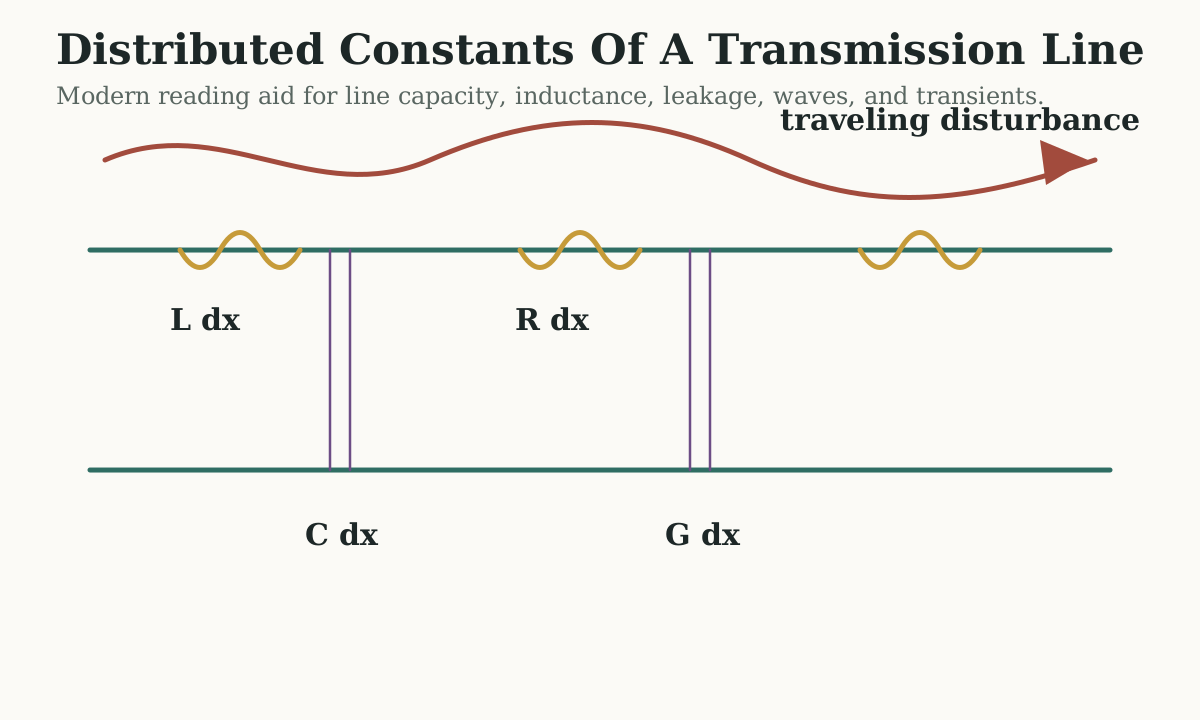
Modern reading aid for line capacity, inductance, leakage, waves, and transients.
distributed-constants, capacity, inductance, waves
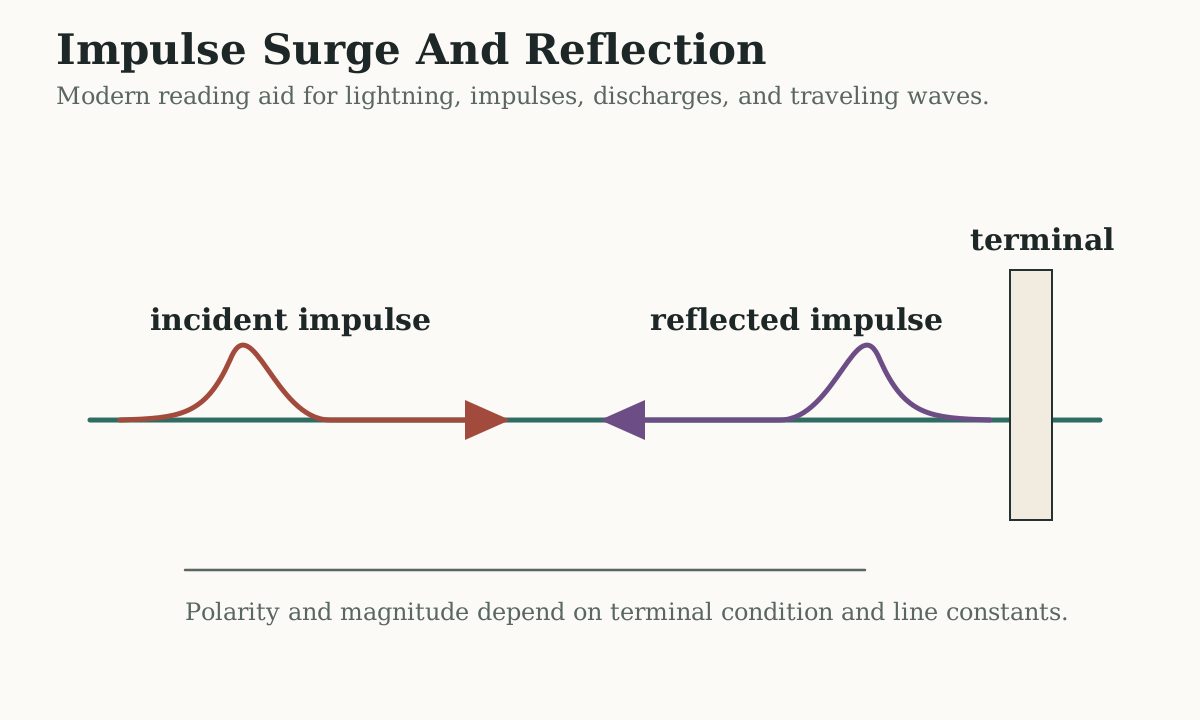
Modern reading aid for lightning, impulses, discharges, and traveling waves.
lightning-surges, impulse-current, traveling-wave
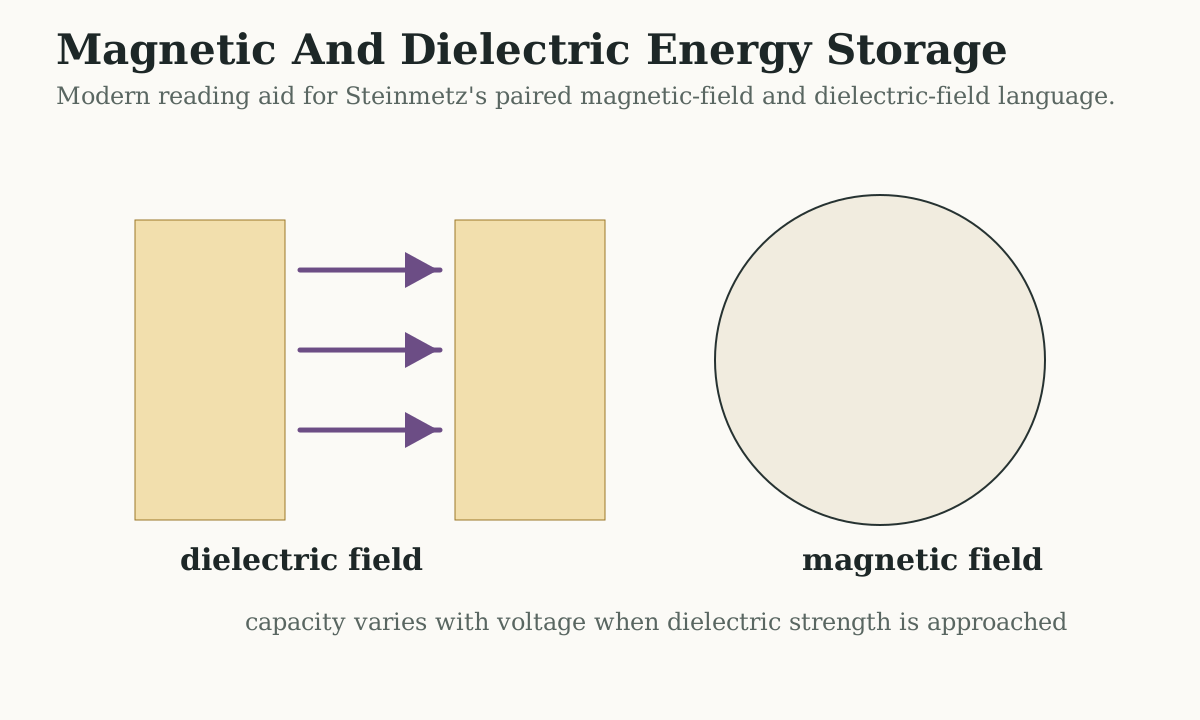
Modern reading aid for Steinmetz’s paired magnetic-field and dielectric-field language.
dielectric-field, magnetic-field, energy-storage
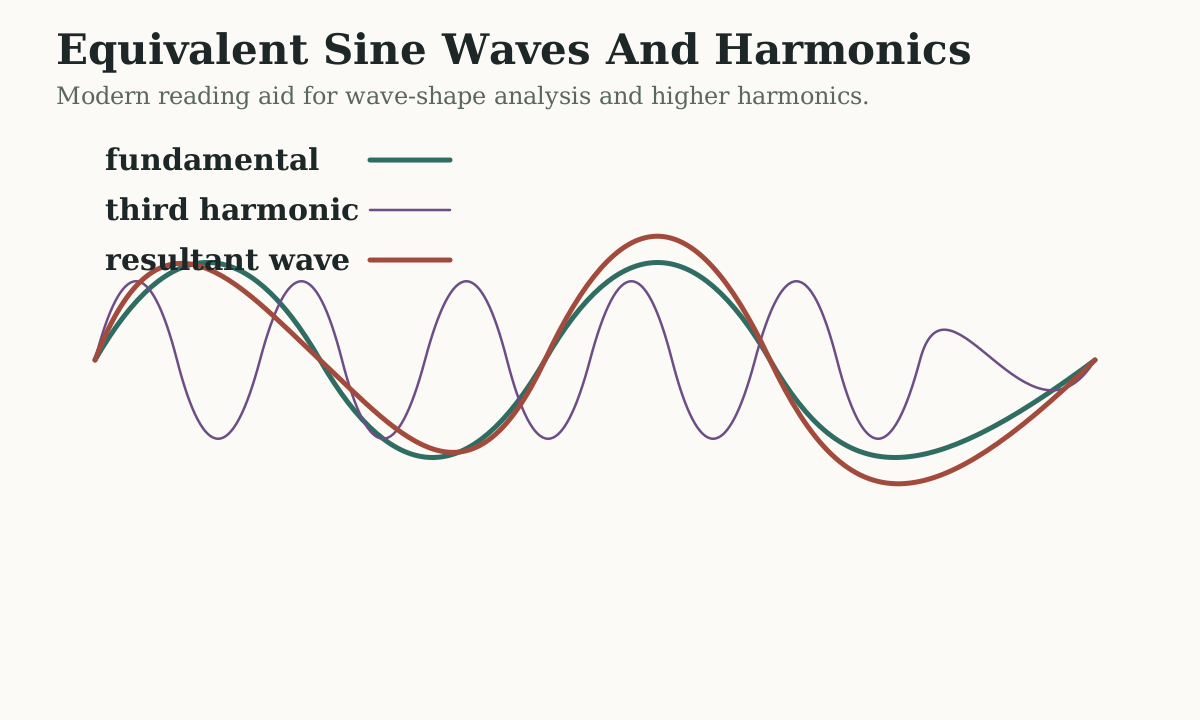
Modern reading aid for wave-shape analysis and higher harmonics.
harmonics, wave-shape, fourier-analysis
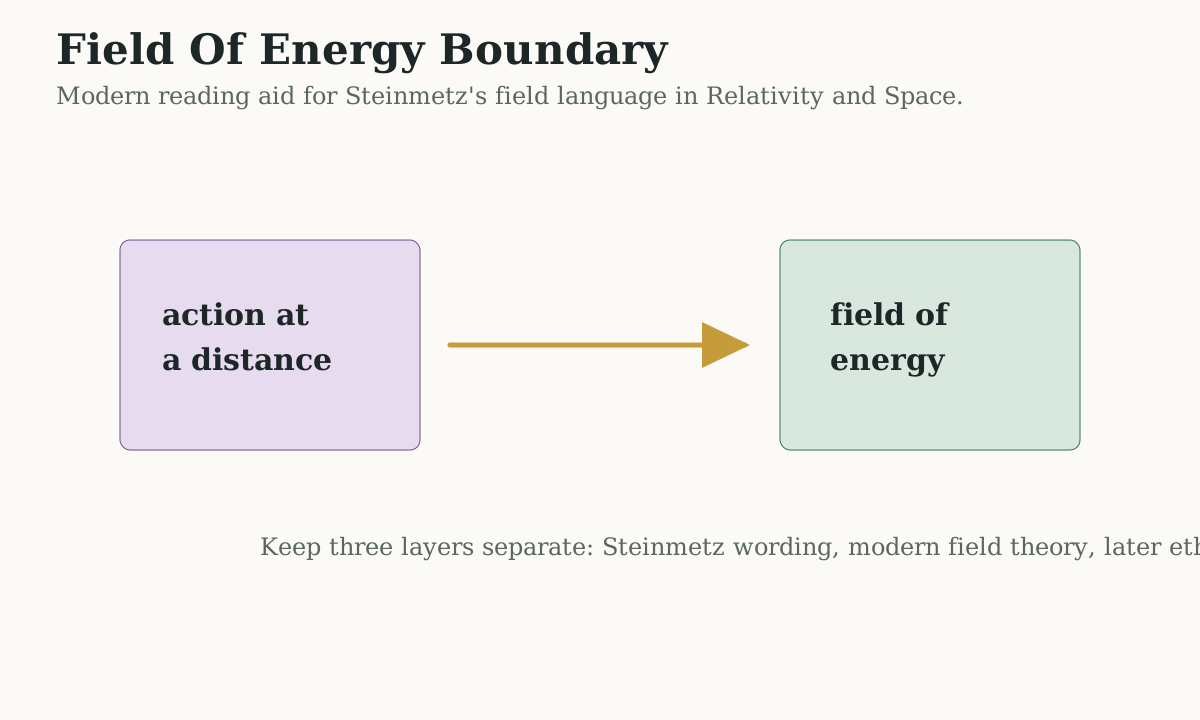
Modern reading aid for Steinmetz’s field language in Relativity and Space.
field-language, ether, relativity, energy-field
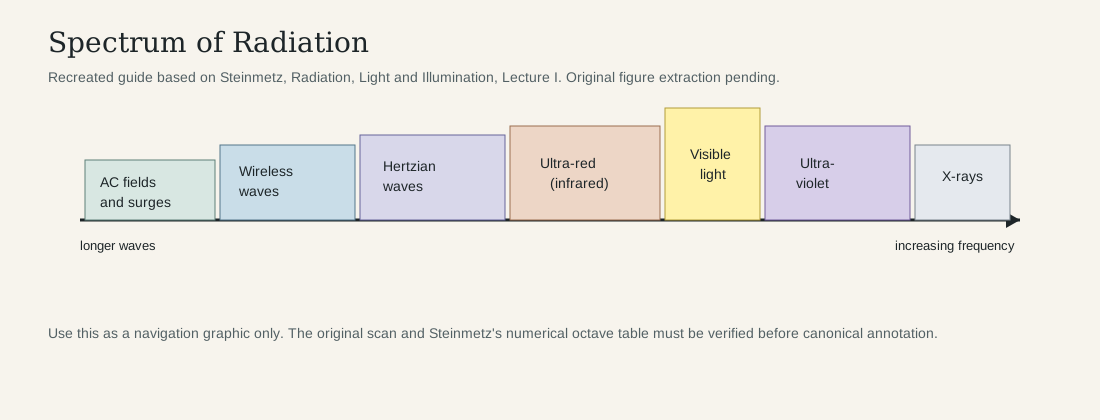
Modern navigation guide for Steinmetz’s electric-wave, visible-light, ultraviolet, and X-ray spectrum bridge.
radiation, electric-waves, frequency, spectrum, ether
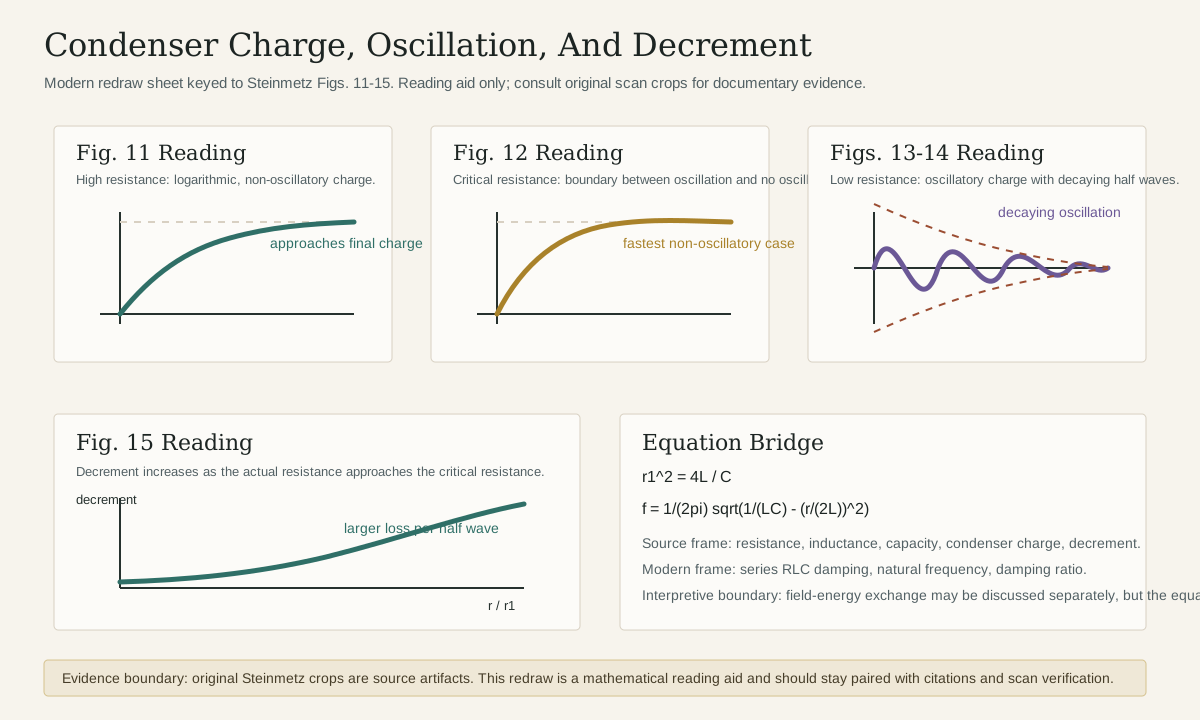
Modern redraw sheet for logarithmic charge, critical damping, oscillatory charge, and decrement.
transient-phenomena, oscillation-damping, capacity, condenser
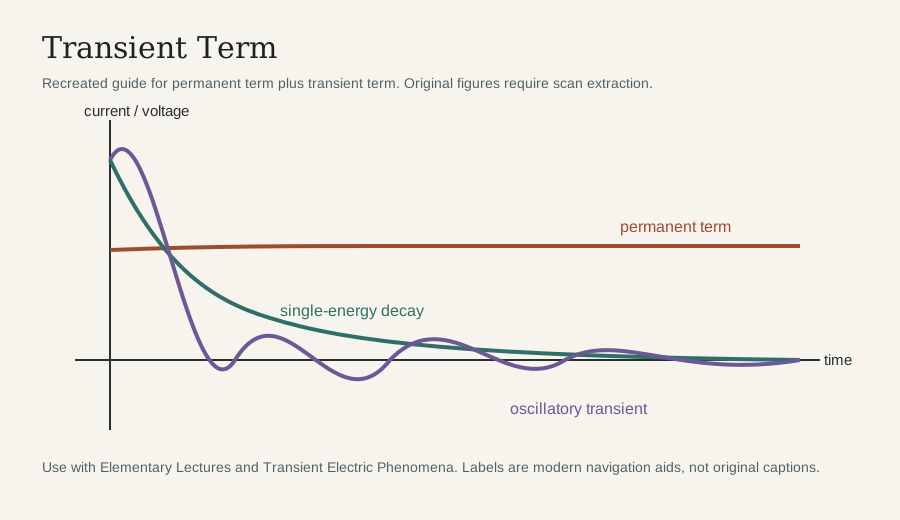
Modern guide for permanent terms, temporary terms, decay, and oscillatory readjustment.
transient-phenomena, oscillation-damping, damping, stored-energy
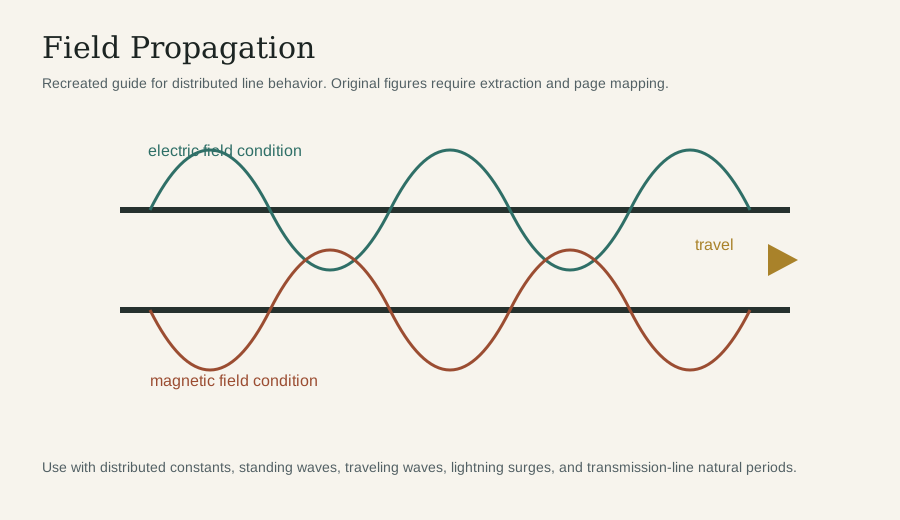
Modern reading aid for distributed constants, standing waves, traveling waves, and surge propagation.
electric-waves, distributed-constants, traveling-wave, lightning-surges
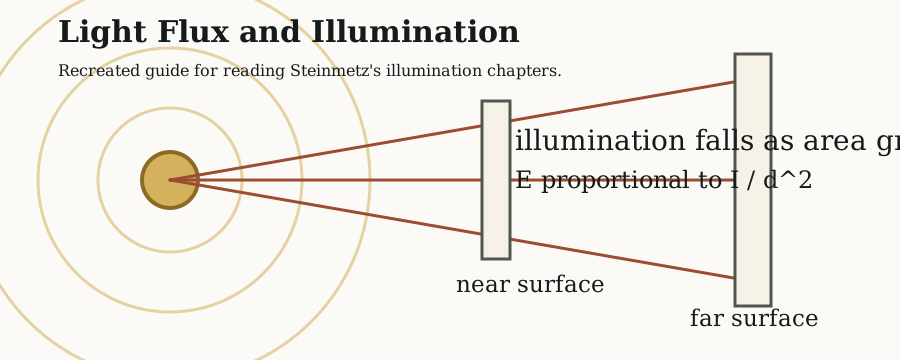
Modern guide for the practical bridge from radiation to visual illumination and light distribution.
illumination, radiation, light-flux, inverse-square
Candidate Figure Leads
Section titled “Candidate Figure Leads”| Candidate | Caption lead | Source section | Routes |
|---|---|---|---|
radiation-light-and-illumination-fig-001Fig. 1 | tion, the time at which the moon M should disappear from sight, FIG. 1. when seen from the earth E, by passing behind Jupiter, 7 (Fig. 1), could be exactly calculated. It was found, however, that some- | Radiation, Light and Illumination Lecture 1: Nature And Different Forms Of Radiation | source workbench |
radiation-light-and-illumination-fig-002Fig. 2 | 5_MOE_S FIG. 2. direction the light reappears. If the disk is slowly revolved, alter- nate light and darkness will be observed, but when the speed in- | Radiation, Light and Illumination Lecture 1: Nature And Different Forms Of Radiation | source workbench |
radiation-light-and-illumination-fig-003Fig. 3 | from the upper surface of the plain glass plate A. A beam of FIG. 3. reflected light a, thus is a combination of a beam b and a beam c. | Radiation, Light and Illumination Lecture 1: Nature And Different Forms Of Radiation | source workbench |
radiation-light-and-illumination-fig-004Fig. 4 | glass plates. At those points dv dv etc. at which the distance FIG. 4. between the two glass plates is J wave length, or j, J, etc., the | Radiation, Light and Illumination Lecture 1: Nature And Different Forms Of Radiation | source workbench |
radiation-light-and-illumination-fig-005Fig. 5 | etc. in the plane of the paper, and thus perpendicular to the ray FIG. 5. of light. In the former case (a longitudinal vibration, as sound) there obviously can be no difference between the directions at | Radiation, Light and Illumination Lecture 1: Nature And Different Forms Of Radiation | source workbench |
radiation-light-and-illumination-fig-009Fig. 9 | it to you, by bringing the rods near to this Crookes’ radiometer, FIG. 9. which is an instrument showing the energy of radiation. It con- sists (Fig. 10) of four aluminum vanes, mounted in a moderately | Radiation, Light and Illumination Lecture 1: Nature And Different Forms Of Radiation | source workbench |
radiation-light-and-illumination-fig-010Fig. 10 | (red, orange and yellow) with increase in temperature, the light FIG. 10. 12 | Radiation, Light and Illumination Lecture 1: Nature And Different Forms Of Radiation | source workbench |
radiation-light-and-illumination-fig-011Fig. 11 | of the lower frequencies of visible radiation, red or orange. FIG. 11. In the tungsten lamp at high brilliancy and more still in the | Radiation, Light and Illumination Lecture 1: Nature And Different Forms Of Radiation | source workbench |
radiation-light-and-illumination-fig-012Fig. 12 | They are used in wireless telegraphy, etc. I here connect (Fig. 12) FIG. 12. the condenser C of the apparatus which I used for operating the ultra-violet arc, to a spark gap Gv of which the one side is con- | Radiation, Light and Illumination Lecture 1: Nature And Different Forms Of Radiation | source workbench |
radiation-light-and-illumination-fig-013Fig. 13 | o — ^^ — o FIG. 13. has been measured by Herz by producing standing waves by combination of main wave and reflected wave. | Radiation, Light and Illumination Lecture 1: Nature And Different Forms Of Radiation | source workbench |
radiation-light-and-illumination-fig-014Fig. 14 | as far as possible when producing light, as they consume power FIG. 14. and so lower the efficiency; the ultra-violet rays are of importance in medicine as germ killers. They are more or less destructive | Radiation, Light and Illumination Lecture 1: Nature And Different Forms Of Radiation | source workbench |
radiation-light-and-illumination-fig-015Fig. 15 | edge of the beam reaches the boundary at D its speed changes FIG. 15. by entering the medium W — decreases in the present instance. Let then Sl = speed of propagation in medium A, S2 = speed of | Radiation, Light and Illumination Lecture 2: Relation Of Bodies To Radiation | source workbench |
radiation-light-and-illumination-fig-016Fig. 16 | medium into another, and the higher frequencies are deflected FIG. 16. more than the lower frequencies, thus showing that the velocity of propagation decreases with an increase of frequency, that is, | Radiation, Light and Illumination Lecture 2: Relation Of Bodies To Radiation | source workbench |
radiation-light-and-illumination-fig-017Fig. 17 | VIOLET FIG. 17. a number of very faint red and orange lines, of which three are indicated dotted in Fig. 17. | Radiation, Light and Illumination Lecture 2: Relation Of Bodies To Radiation | source workbench |
radiation-light-and-illumination-fig-018Fig. 18 | perature rise, their brilliancy is greatly increased. FIG. 18. Combinations of the different types of spectra: continuous spectrum, line spectrum, band spectrum, reversed spectrum, | Radiation, Light and Illumination Lecture 2: Relation Of Bodies To Radiation | source workbench |
radiation-light-and-illumination-fig-019Fig. 19 | and the body thus acts as a mirror, that is, gives a virtual image FIG. 19. back of it as shown in dotted line in Fig. 18. In the latter case (Fig. 19) the light is reflected irregularly in all directions. | Radiation, Light and Illumination Lecture 2: Relation Of Bodies To Radiation | source workbench |
radiation-light-and-illumination-fig-021Fig. 21 | VIOLET FIG. 21. in the ultra-red and ultra-violet, where no power of radiation can produce visibility. It thus varies about as indicated in Fig. 22. | Radiation, Light and Illumination Lecture 3: Physiological Effects Of Radiation | source workbench |
radiation-light-and-illumination-fig-022Fig. 22 | the basis of equal ease in distinguishing objects. As the pur- FIG. 22. pose for which light is used is to distinguish objects, the correct comparison of lights obviously is on the basis of equal distinctness | Radiation, Light and Illumination Lecture 3: Physiological Effects Of Radiation | source workbench |
radiation-light-and-illumination-fig-023Fig. 23 | v FIG. 23. meter candles (or rather log i) as abscissas, for red light, wave length 65.0; orange yellow light, wave length 59; bluish green | Radiation, Light and Illumination Lecture 3: Physiological Effects Of Radiation | source workbench |
radiation-light-and-illumination-fig-024Fig. 24 | \ FIG. 24. (1 meter-candle is the illumination produced by 1 candle power | Radiation, Light and Illumination Lecture 3: Physiological Effects Of Radiation | source workbench |
radiation-light-and-illumination-fig-025Fig. 25 | S FIG. 25. 62 for high intensities and changes in approximately the same range of intensities in which lwo changes; ks is also plotted in | Radiation, Light and Illumination Lecture 3: Physiological Effects Of Radiation | source workbench |
radiation-light-and-illumination-fig-026Fig. 26 | YELLOW GREEN FIG. 26. carbon filament would be somewhat like C. That is, the physio- | Radiation, Light and Illumination Lecture 3: Physiological Effects Of Radiation | source workbench |
radiation-light-and-illumination-fig-027Fig. 27 | fore, increase enormously with the increase of temperature. FIG. 27. With bodies in a vacuum, the radiation power is the power input and this above law can be used to calculate the tempera- | Radiation, Light and Illumination Lecture 5: Temperature Radiation | source workbench |
radiation-light-and-illumination-fig-028Fig. 28 | weight, exhibit a periodicity in their properties which permits FIG. 28. a systematic study of their properties. In diagram Fig. 28 the | Radiation, Light and Illumination Lecture 5: Temperature Radiation | source workbench |
Formula Leads That Pair With The Visual Topic
Section titled “Formula Leads That Pair With The Visual Topic”| Candidate | OCR/PDF text | Source section | Routes |
|---|---|---|---|
elementary-lectures-electric-discharges-waves-impulses-eq-candidate-0195transients-oscillation | i = io cos (0 - 7) = io cos 7 cos <j> + i0 sin 7 sin | Elementary Lectures on Electric Discharges, Waves and Impulses, and Other Transients Lecture 6: Double-Energy Transients | source workbench |
electric-discharges-waves-impulses-1914-eq-candidate-0240transients-oscillation | e = 2;oCe-”’ sin (0 =F co - 7) j | Elementary Lectures on Electric Discharges, Waves and Impulses, and Other Transients Lecture 7: Line Oscillations | source workbench |
electric-discharges-waves-impulses-1914-eq-candidate-0293transients-oscillation | i = e~ ”’ J ai cos </) cos co + 6i sin cf) cos co + Ci cos 0 sin co | Elementary Lectures on Electric Discharges, Waves and Impulses, and Other Transients Lecture 7: Line Oscillations | source workbench |
elementary-lectures-electric-discharges-waves-impulses-eq-candidate-0220transients-oscillation | if = 140 cos 0.2 1 - 80 sin 0.2 1, | Elementary Lectures on Electric Discharges, Waves and Impulses, and Other Transients Lecture 6: Double-Energy Transients | source workbench |
elementary-lectures-electric-discharges-waves-impulses-eq-candidate-0014transients-oscillation | w=j*pdt, (10) | Elementary Lectures on Electric Discharges, Waves and Impulses, and Other Transients Lecture 2: The Electric Field | source workbench |
electric-discharges-waves-impulses-1914-eq-candidate-0018transients-oscillation | f = j (13) | Elementary Lectures on Electric Discharges, Waves and Impulses, and Other Transients Lecture 2: The Electric Field | source workbench |
electric-discharges-waves-impulses-1914-eq-candidate-0029transients-oscillation | K = j^; (21) | Elementary Lectures on Electric Discharges, Waves and Impulses, and Other Transients Lecture 2: The Electric Field | source workbench |
elementary-lectures-electric-discharges-waves-impulses-eq-candidate-0037transients-oscillation | (B = -j =/z JClinespercm2. | Elementary Lectures on Electric Discharges, Waves and Impulses, and Other Transients Lecture 2: The Electric Field | source workbench |
elementary-lectures-electric-discharges-waves-impulses-eq-candidate-0039transients-oscillation | 7 = -j = yG am- | Elementary Lectures on Electric Discharges, Waves and Impulses, and Other Transients Lecture 2: The Electric Field | source workbench |
elementary-lectures-electric-discharges-waves-impulses-eq-candidate-0178transients-oscillation | io = eo y j = e02/o. (11) | Elementary Lectures on Electric Discharges, Waves and Impulses, and Other Transients Lecture 6: Double-Energy Transients | source workbench |
electric-discharges-waves-impulses-1914-eq-candidate-0135transients-oscillation | (S!,J = 20,000 lines per cm^. * | Elementary Lectures on Electric Discharges, Waves and Impulses, and Other Transients Lecture 5: Single-Energy Tra.Nsient Of Ironclad Circuit | source workbench |
elementary-lectures-electric-discharges-waves-impulses-eq-candidate-0185transients-oscillation | ii = IQ cos 7 = initial transient current. (14) | Elementary Lectures on Electric Discharges, Waves and Impulses, and Other Transients Lecture 6: Double-Energy Transients | source workbench |
elementary-lectures-electric-discharges-waves-impulses-eq-candidate-0186transients-oscillation | e = e0 sin (0 - 7), (15) | Elementary Lectures on Electric Discharges, Waves and Impulses, and Other Transients Lecture 6: Double-Energy Transients | source workbench |
elementary-lectures-electric-discharges-waves-impulses-eq-candidate-0187transients-oscillation | ei = - e0 sin 7 = initial value of transient voltage. (16) | Elementary Lectures on Electric Discharges, Waves and Impulses, and Other Transients Lecture 6: Double-Energy Transients | source workbench |
elementary-lectures-electric-discharges-waves-impulses-eq-candidate-0196transients-oscillation | i = i\ cos 1/001 sin - , (21) | Elementary Lectures on Electric Discharges, Waves and Impulses, and Other Transients Lecture 6: Double-Energy Transients | source workbench |
elementary-lectures-electric-discharges-waves-impulses-eq-candidate-0197transients-oscillation | e = e\ cos - + z0ii sin - , (22) | Elementary Lectures on Electric Discharges, Waves and Impulses, and Other Transients Lecture 6: Double-Energy Transients | source workbench |
electric-discharges-waves-impulses-1914-eq-candidate-0159transients-oscillation | T = 2.92 - { 9.21 log’^ , ,\ . + .921 log’^ i ’ ^ ^ | Elementary Lectures on Electric Discharges, Waves and Impulses, and Other Transients Lecture 5: Single-Energy Tra.Nsient Of Ironclad Circuit | source workbench |
electric-discharges-waves-impulses-1914-eq-candidate-0162transients-oscillation | division with log^^e = .4343. | Elementary Lectures on Electric Discharges, Waves and Impulses, and Other Transients Lecture 5: Single-Energy Tra.Nsient Of Ironclad Circuit | source workbench |
Editorial Use
Section titled “Editorial Use”This gallery is meant for discovery, not final citation. The strongest current source distribution is: Elementary Lectures on Electric Discharges, Waves and Impulses, and Other Transients (634), Radiation, Light and Illumination (398), General Lectures on Electrical Engineering (148), Theory and Calculation of Alternating Current Phenomena (74). Promote a diagram or formula only after the scan, page label, exact caption, and mathematical notation are checked.