Radiation
Steinmetz’s Meaning
Section titled “Steinmetz’s Meaning”Radiation is energy in transit. It may be produced from heat or electrical energy, but while traveling it is radiation, not heat.
That distinction is the first important conceptual discipline in Radiation, Light and Illumination. Steinmetz does not let the reader confuse the form of energy during transmission with the form of energy after absorption. In modern terms, he is tracking the physical state of the energy through an emitter, a propagating field/wave process, and an absorber.
Modern Equivalent
Section titled “Modern Equivalent”Electromagnetic radiation carrying energy through space and transferring energy to matter upon absorption.
For the archive, this concept should not be treated only as optics. Steinmetz’s first lecture places visible light, ultra-red radiation, ultra-violet radiation, electric waves, and alternating-current field effects on one frequency/wavelength scale. That makes radiation a cross-link between illumination, wireless telegraphy, high-frequency phenomena, circuit fields, and transient propagation.
Mathematical Explanation
Section titled “Mathematical Explanation”This relation lets Steinmetz place electric waves, visible light, ultraviolet, and X-rays on one spectrum.
Diagrammatic Explanation
Section titled “Diagrammatic Explanation”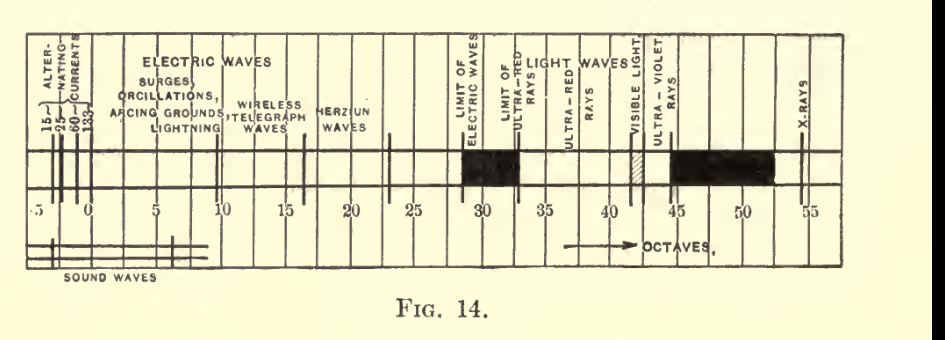
Steinmetz’s spectrum diagram from printed page 18.
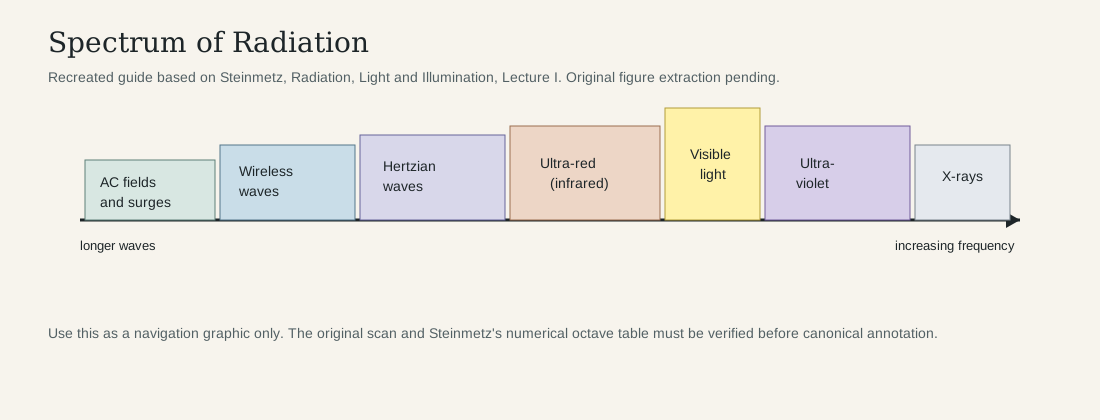
Readable modern guide aligned with the archive’s concept map.
Current Research Tasks
Section titled “Current Research Tasks”- Verify Steinmetz’s exact wording around “radiant heat” against the scan.
- Extract Fig. 14 and align the recreated spectrum guide with the original table.
- Link radiation to electric waves, illumination, temperature radiation, and physiological perception.
- Compare this 1909 usage with Steinmetz’s other uses of electric field and wave language.
Ether-Field Interpretive Reading
Interpretive only: a field-first reading emphasizes that radiation is a real energetic process between emitter and absorber. Steinmetz’s historical ether language may support inquiry, but the archive keeps it distinct from modern nonstandard interpretation.
Source-Grounded Dossier
Section titled “Source-Grounded Dossier”Generated evidence layer: this dossier is built from the processed concept concordance. Counts and snippets are OCR/PDF-text aids, not final quotations. Verify against scans before making exact claims.
Candidate occurrences tracked for this page.
Sources with at least one hit.
Sections, lectures, chapters, or report divisions to review.
What The Current Corpus Shows
Section titled “What The Current Corpus Shows”Read this concept as the bridge from physics to illumination engineering: Steinmetz treats radiation as energy in transit before later lectures convert that physical idea into measurement, lamps, flux, distribution, and visual response.
The strongest current source concentration is Radiation, Light and Illumination with 2387 candidate hits across 28 sections.
The dossier is meant to turn a concept page into a research workbench: begin with Steinmetz’s source wording, then add modern interpretation, mathematical reconstruction, historical context, and any ether-field reading as separate layers.
Terms And Aliases Tracked
Section titled “Terms And Aliases Tracked”Radiation, radiant energy, radiation, radiations, Light, light, luminous, visible light, electric radiation, electrical radiation
Concordance Records
Section titled “Concordance Records”Radiation - Light - Electrical Radiation
Source Distribution
Section titled “Source Distribution”| Source | Candidate Hits | Sections | Concepts represented |
|---|---|---|---|
| Radiation, Light and Illumination | 2387 | 28 | Electrical Radiation, Light, Radiation |
| General Lectures on Electrical Engineering | 407 | 14 | Light, Radiation |
| Four Lectures on Relativity and Space | 159 | 6 | Light, Radiation |
| Theory and Calculation of Transient Electric Phenomena and Oscillations | 63 | 19 | Electrical Radiation, Light, Radiation |
| Theory and Calculation of Electric Circuits | 24 | 6 | Light, Radiation |
| Theoretical Elements of Electrical Engineering | 18 | 9 | Light, Radiation |
| Theory and Calculation of Alternating Current Phenomena | 18 | 12 | Light, Radiation |
| Theory and Calculation of Electric Apparatus | 16 | 8 | Light, Radiation |
Priority Passages To Read
Section titled “Priority Passages To Read”Lecture 17: Arc Lighting - 359 candidate hits
Source: General Lectures on Electrical Engineering (1908)
Location: lines 9920-12795 - Tracked concepts: Light, Radiation
Open source text - Open chapter workbench
... to do any more strictly with a problem of physics, but that we are on .the borderland between applied physics, that is engineering, and physiology. Light is not a physical quantity, but it is the physiological effeot exerted upon the human eye by certain radiations. There are different forms of energy, all convertible into each other, as magnetic ener...... locity of about 188,000 miles per second; and it is a transverse vibration, differing from the vibratory energy of sound in this respect, that the sound waves are longitudinal, that is, the vibration is in the direction of the beam, while the vibration of radiation is transverse. Radiating energy can be derived from other forms of energy, for instance...Lecture 5: Temperature Radiation - 292 candidate hits
Source: Radiation, Light and Illumination (1909)
Location: lines 3946-5076 - Tracked concepts: Light, Radiation
Open source text - Open chapter workbench
LECTURE V. TEMPERATURE RADIATION. 34. The most common method of producing radiation is by impressing heat energy upon a body and thereby raising its tem- perature. Up to a short time ago this was the only method avail- able for the production of artificial light. The temperature is rai ...LECTURE V. TEMPERATURE RADIATION. 34. The most common method of producing radiation is by impressing heat energy upon a body and thereby raising its tem- perature. Up to a short time ago this was the only method avail- able for the production of artificial light. The temperature is raised by heating a body by the transformation of chemic ...Lecture 3: Physiological Effects Of Radiation - 276 candidate hits
Source: Radiation, Light and Illumination (1909)
Location: lines 2366-3638 - Tracked concepts: Light, Radiation
Open source text - Open chapter workbench
LECTURE III. PHYSIOLOGICAL EFFECTS OF RADIATION. Visibility. 20. The most important physiological effect is the visibility of the narrow range of radiation, of less than one octave, between wave length 76 X 10~6 and 39 X 1Q-6. The range of intensity of illumination, over which the eye can see with ...LECTURE III. PHYSIOLOGICAL EFFECTS OF RADIATION. Visibility. 20. The most important physiological effect is the visibility of the narrow range of radiation, of less than one octave, between wave length 76 X 10~6 and 39 X 1Q-6. The range of intensity of illumination, over which the eye can see with practically equal comfort, is enormous: the average intens...Lecture 12: Illumination And Illuminating Engineering - 268 candidate hits
Source: Radiation, Light and Illumination (1909)
Location: lines 16485-17445 - Tracked concepts: Light, Radiation
Open source text - Open chapter workbench
... ities with which we have to deal in illumi- nating engineering thus are : The intensity of the light source or the illuminant, and its brilliancy, that is, the flux density at the surface of the illuminant; The flux of light, that is, the total visible radiation issuing from the illuminant; 256 ILLUMINATION AND ILLUMINATING ENGINEERING. 257 The light...... ible radia- tion of the mercury lamp or a Moore tube as well as that of a point source - by adding all the flux densities intercepted by any surface enclosing the source of light. In a point source of light, the intensity, in candles, is the total 258 RADIATION, LIGHT, AND ILLUMINATION. flux of light, in lumens, divided by 4 x. In any illuminant which...Lecture 10: Light Flux And Distribution - 250 candidate hits
Source: Radiation, Light and Illumination (1909)
Location: lines 9389-12573 - Tracked concepts: Light, Radiation
Open source text - Open chapter workbench
LECTURE X. LIGHT FLUX AND DISTRIBUTION. 86. The light flux of an illuminant is its total radiation power, in physiological measure. It therefore is the useful output of the illuminant, and the efficiency of an illuminant thus is the ratio of the total light flux divided by the power input. In general, the distribution of the light flux throughout spa ...... coordinates does not give a fair representation of the total light flux, or the mean spherical intensity of the light source, but on the contrary frequently is very misleading. When com- paring different polar curves of intensity distribution, it is 188 RADIATION, LIGHT, AND ILLUMINATION. impossible to avoid the impression of the area of the curve as...Lecture 2: Relation Of Bodies To Radiation - 197 candidate hits
Source: Radiation, Light and Illumination (1909)
Location: lines 1549-2365 - Tracked concepts: Electrical Radiation, Light, Radiation
Open source text - Open chapter workbench
LECTURE II. RELATION OF BODIES TO RADIATION. 9. For convenience, the total range of known radiations can be divided into two classes, the electric waves and the light waves, which are separated from each other by the blank space in the middle of the spectrum of radiation (Fig. 14). Under light wa ...LECTURE II. RELATION OF BODIES TO RADIATION. 9. For convenience, the total range of known radiations can be divided into two classes, the electric waves and the light waves, which are separated from each other by the blank space in the middle of the spectrum of radiation (Fig. 14). Under light waves we here include also the invisible ultra-red radiation ...Reading Layers To Build Out
Section titled “Reading Layers To Build Out”| Layer | What to add next |
|---|---|
| Steinmetz wording | Pull exact source passages only after scan verification; keep OCR text labeled until then. |
| Modern engineering reading | Translate the source usage into present electrical-engineering or physics language without erasing the older vocabulary. |
| Mathematical layer | Link equations, variables, diagrams, and worked examples when the concept has formula candidates. |
| Historical layer | Identify whether the term is still used, renamed, absorbed into modern theory, or historically obsolete. |
| Ether-field interpretation | Keep interpretive readings separate from Steinmetz’s explicit claim and from modern physics. |
| Open questions | Record places where the concordance suggests a lead but the scan or edition has not yet been checked. |
Next Editorial Actions
Section titled “Next Editorial Actions”- Open the highest-priority source-text passages above and verify the wording against scans.
- Promote exact definitions, equations, diagrams, and hidden-gem passages into this page with source references.
- Add related concept links, equation pages, and diagram pages once the evidence is scan checked.
- Keep speculative or Wheeler-style readings in explicitly labeled interpretation blocks.