Lecture I: Nature and Different Forms of Radiation
Core Reading
Section titled “Core Reading”Steinmetz begins by defining radiation as energy in transit. He then measures light velocity, argues for wave motion, introduces ether as the historical medium of that wave motion, and places electric waves and light waves on one spectrum of frequency and wavelength.
The central interpretive discipline is that Steinmetz is not starting with “light” as a human sensation. He starts with radiation as a physical transfer of energy, then identifies the visible part of radiation as only one region of a wider spectrum. This protects the reader from confusing an effect in the eye with the physical wave process that carries energy before it is absorbed.
Major Concepts
Section titled “Major Concepts”- Radiation as energy.
- Light as a visible band of radiation.
- Wave motion, phase, interference, and polarization.
- Ether as historical wave medium.
- Electric waves, wireless waves, Hertzian waves, and AC fields.
- Wavelength-frequency relation.
Mathematical Spine
Section titled “Mathematical Spine”Steinmetz uses S = 3 x 10^10 cm/s. For a 60-cycle alternating current, this gives a wavelength of about 5,000 km, which explains why ordinary low-frequency circuit fields are usually not treated as propagating waves.
Reading Layers
Section titled “Reading Layers”Steinmetz Explicit Layer
The OCR seed indicates that Steinmetz treats radiation as an energy process, organizes it by wave velocity, frequency, and wavelength, and includes electric waves and light in one scale. Exact wording remains scan-verification work.
Modern Engineering Layer
A modern engineer can read this as electromagnetic radiation plus a scale argument: at ordinary power frequency, wavelengths are enormous, while at wireless and optical frequencies propagation and wave behavior become central.
Historical Language Layer
The ether discussion belongs to the historical vocabulary of wave propagation. The archive should preserve it accurately before comparing it with either modern field theory or nonstandard ether-field interpretations.
Modern Electrical Engineering Interpretation
Lecture I is a bridge between optics and electromagnetic engineering. Modern readers can translate Steinmetz’s electric waves into electromagnetic waves and his AC field discussion into the scale distinction between lumped circuits and distributed/wave behavior.
Ether-Field Interpretive Reading
Interpretive only: the ether passage is historically real and important, but it should not be inflated into proof of any later ether system. A disciplined reading can ask whether Steinmetz’s field language preserves a concrete account of energy transfer that modern abstractions often hide.
Hidden Gems
Section titled “Hidden Gems”- Radiation is not heat while traveling.
- AC circuit fields are described as radiation waves whose wavelength is usually too large to matter in ordinary circuits.
- Electric waves and light waves are treated on one frequency scale.
- The lecture makes visible a scale distinction that modern circuit courses often hide: the same field theory can look like lumped circuit behavior at one frequency and wave propagation at another.
Diagram Seed
Section titled “Diagram Seed”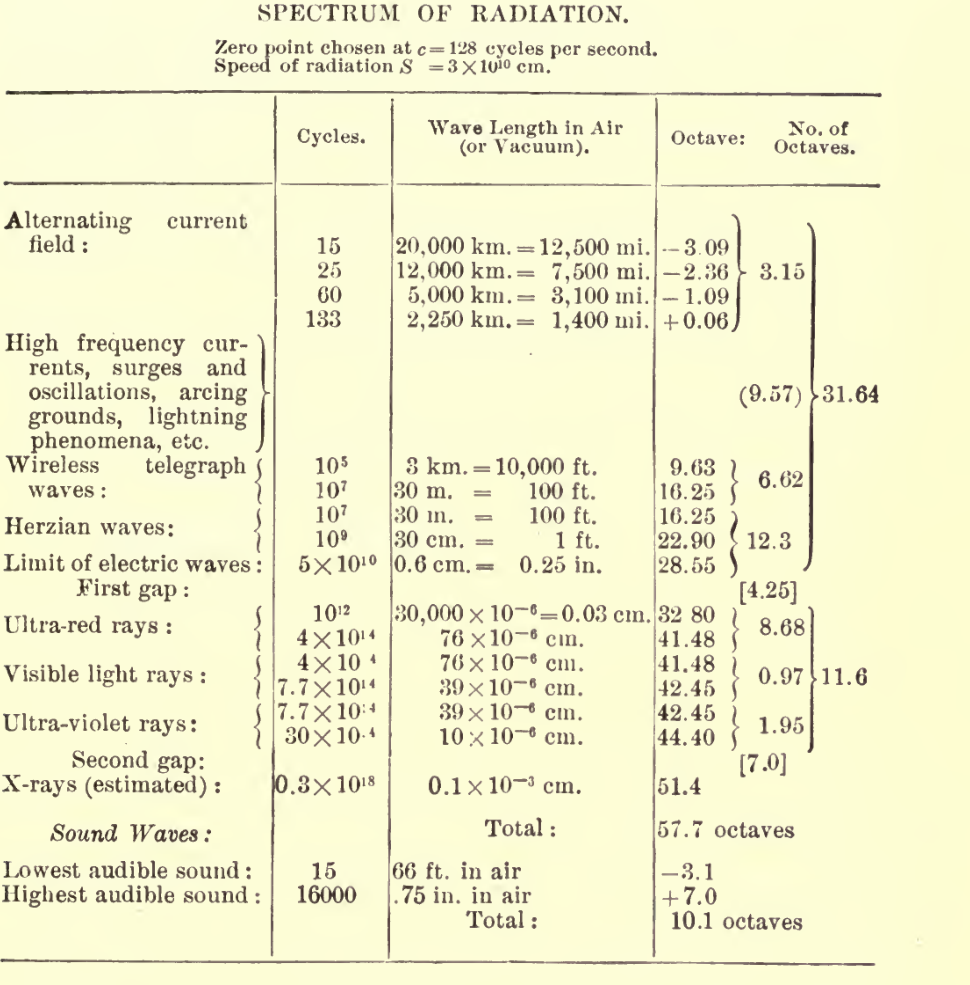
Scan crop from printed page 17. This is the tabular source behind the spectrum discussion and the Fig. 14 graphic.
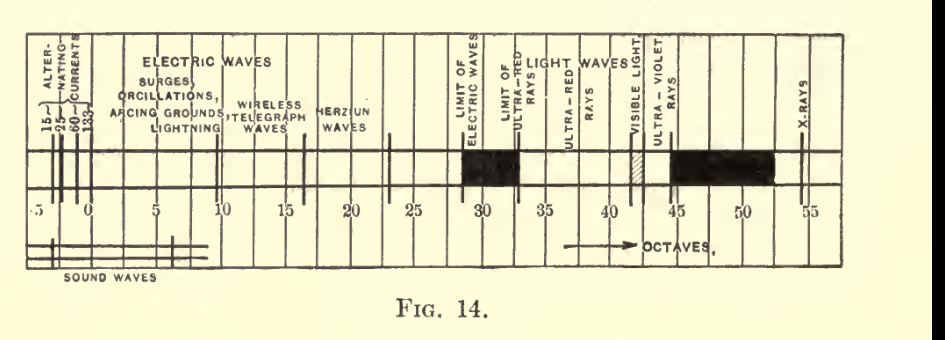
Scan crop from printed page 18. This is the first original figure promoted into the diagram archive.
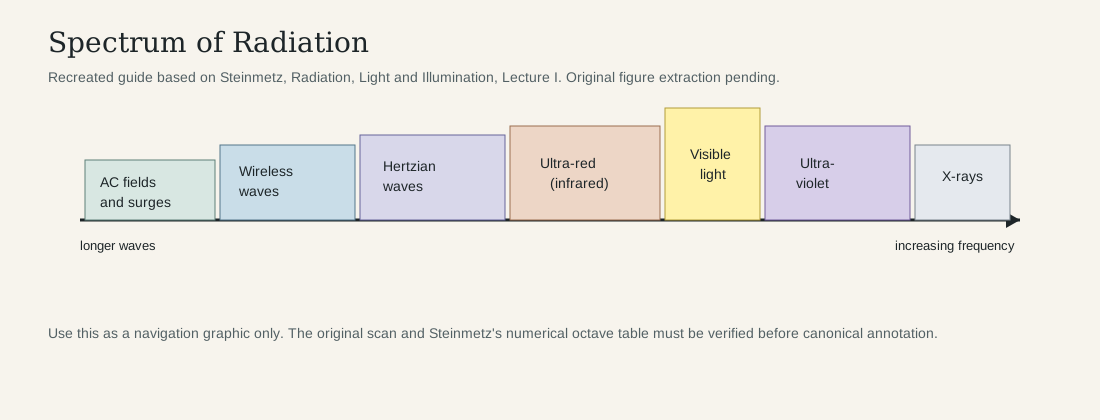
Modern navigation diagram based on the same spectrum concept; not a replacement for the source figure.
Cross-Links To Build
Section titled “Cross-Links To Build”- Radiation -> electric waves -> transient wave propagation.
- Wavelength/frequency relation -> distributed constants -> transmission line behavior.
- Ether language -> historical field ontology -> labeled interpretive readings.
- Visible light -> illumination -> physiological response and engineering measurement.
Verification Tasks
Section titled “Verification Tasks”- Correct OCR in the formulas and units.
- Extract and review Figs. 1-13 from the PDF.
- Create a page map from book pages to OCR line ranges.
- Compare the ether language with Steinmetz’s other works.