Power-Limiting Reactors and Synchronism
Why This Report Matters
Section titled “Why This Report Matters”This report shows Steinmetz outside the textbook voice. The problem is not merely “what is reactance?” or “what is synchronism?” The problem is a large power system that experiences a fault, clears the fault, and then fails to recover normally because station sections appear to have slipped out of step.
The report therefore belongs beside the transient books, the alternating-current symbolic method, and the protection-patent material. It is an applied case where reactance is not only a formula term. It is an architectural tool for controlling how a disturbance spreads through a real system.
Steinmetz’s Diagnostic Structure
Section titled “Steinmetz’s Diagnostic Structure”Steinmetz separates the event into layers:
- The initiating short circuit and the protective devices that must clear it.
- The local and nonlocal effect of the fault through tie cables and station interconnections.
- The dropping out of synchronous machines and the sudden change of load on station sections.
- The possible loss of synchronism between station groups after the fault clears.
- The failure of normal voltage to return while station sections drift against each other.
- The role of power-limiting reactors in reducing local concentration of power without destroying the synchronizing relation needed to hold station sections in step.
That layered diagnosis is the important thing. He does not treat a reactor as an isolated component. He treats it as part of system behavior under disturbance.
The Power-Limiting Reactor Problem
Section titled “The Power-Limiting Reactor Problem”The report recommends power-limiting reactance between station sections, especially where low-reactance tie paths allow trouble in one station to involve another station too strongly. In modern terms, the reactor reduces fault-current contribution and limits how much one section can force the rest of the system during a disturbance.
But Steinmetz also sees the tradeoff. A reactor that limits power flow also limits synchronizing power. Too little reactance allows a fault to pull too much of the system into the disturbance. Too much isolation can make it harder for station sections to hold or recover synchronism. The design problem is therefore not “more reactance is always better.” It is finding the reactance relation that contains trouble while still preserving a restoring path.
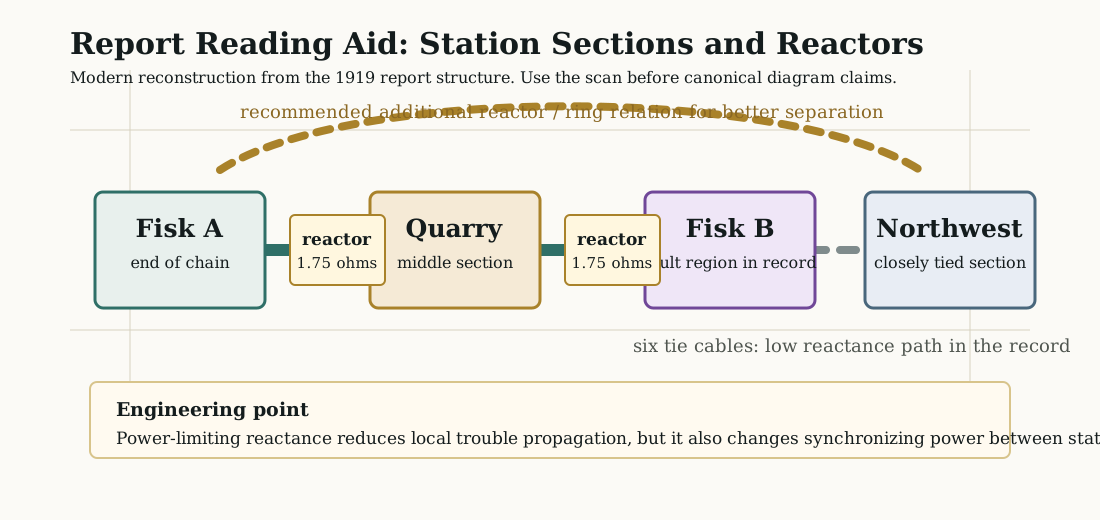
The visual aid summarizes the report’s station-section logic: Fisk A, Quarry, Fisk B, Northwest, existing reactors, low-reactance tie cables, and the ring/reinforcement recommendation.
Modern Electrical Engineering Interpretation
Section titled “Modern Electrical Engineering Interpretation”Modern language would divide the report across several specialties:
- Protection coordination: relays, current transformers, breaker mechanisms, differential protection, and feeder arrangements.
- Fault-current limitation: series reactors used to reduce short-circuit contribution and section-to-section disturbance.
- Transient stability: whether synchronous machines remain in step after a fault and load rejection.
- Out-of-step operation: station sections drifting in phase or frequency after a disturbance.
- System restoration: why clearing the fault is not enough if the remaining system does not regain voltage and synchronism.
The historical value is that Steinmetz handles these as one engineering problem. Protection, reactance, mechanical governor response, machine excitation, and synchronizing power all meet in the same diagnosis.
Mathematical Spine
Section titled “Mathematical Spine”The appendix begins with two equal-voltage alternators or groups of alternators connected while out of phase. The PDF text is damaged, but the candidate structure is clear enough to route future scan review:
These are modernized reading forms, not canonical transcriptions. The source-located equation records are stored in processed/commonwealth-edison-generating-system-trouble/equations.json and must be checked against the page images before being promoted.
The meaning is straightforward: the out-of-step voltage difference drives an interchange current through the interconnection impedance. That current produces power exchange. Depending on phase relation, frequency slip, voltage, resistance, reactance, and machine characteristics, the exchange may pull sections together, produce oscillation, or allow them to keep slipping.
Event Record Reading
Section titled “Event Record Reading”The report’s event record is especially valuable because it joins numeric apparatus facts with sequence-of-events reasoning. It records four 1919 troubles and describes station sections, the stated 1.75-ohm reactors, six tie cables between Fisk B and Northwest, synchronous machines dropping out, busbar voltage falling, and sections remaining out of synchronism for minutes after the original fault.
The hidden lesson is that clearing a short circuit does not guarantee recovery. The system can enter a secondary state: machines no longer share the same phase or frequency relation, voltage remains depressed, and power flows through unintended paths. That is the report’s bridge to transient stability.
Diagram and Figure Work
Section titled “Diagram and Figure Work”The parser found a candidate reference to Appendix Figure 1 around PDF page 32. The current public visual is only a modern guide. The next image-custody step is to render the source page, crop the original figure, save a manifest with checksum, and then compare the scan against the appendix equations.
Relation to Tesla-Era Electrical Science
Section titled “Relation to Tesla-Era Electrical Science”This report is not about high-frequency invention or wireless phenomena. Its Tesla-era relevance is narrower and practical: it belongs to the same historical electrical world in which large alternating-current systems, synchronous machines, protection, and high-power disturbances were still being made mathematically legible.
The disciplined comparison is this: Tesla-era experiment often emphasizes disruptive discharge, high frequency, and resonance; Steinmetz here emphasizes the stability of utility-scale AC machines and station sections after faults. Both concern electrical disturbance, but they operate in different engineering registers.
Ether-Field Interpretive Reading
Interpretive only: a field-centered reader may describe the reactor as adding magnetic field energy storage and opposition to sudden current concentration, while the synchronous machines exchange energy according to phase relation. That is a useful conceptual reading, but it is not evidence that the report is making an ether argument. In this source, Steinmetz’s explicit frame is power-system engineering.