Transient Phenomena: Condenser Charge and Discharge
Why This Section Matters
Section titled “Why This Section Matters”Steinmetz’s condenser charge and discharge treatment is one of the clearest bridges between textbook RLC transients and the older electrical language of capacity, inductance, oscillation, and decrement.
The figures show the same physical system moving through distinct regimes:
- logarithmic or non-oscillatory charge,
- critical charge,
- oscillating charge with decaying amplitude,
- decrement as a function of resistance compared with critical resistance.
This is not just a circuit exercise. It is the archive’s first source-grounded visual path into how stored magnetic and electrostatic energy exchange, overshoot, decay, and settle.
Source Figures
Section titled “Source Figures”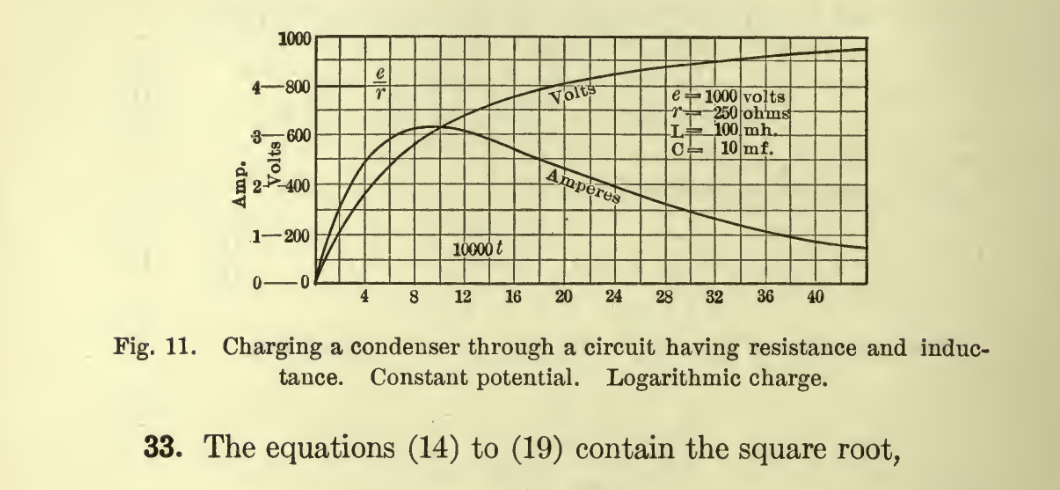
Logarithmic condenser charge at high resistance.
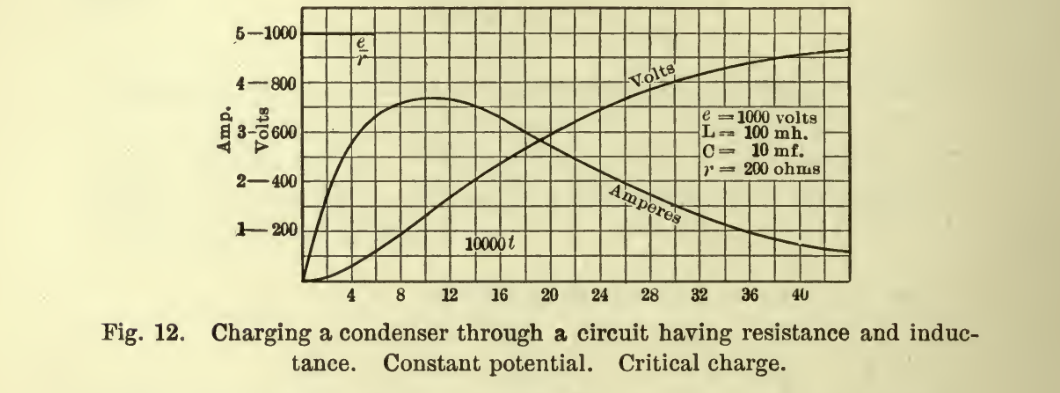
Critical charge, the boundary between non-oscillating and oscillating response.
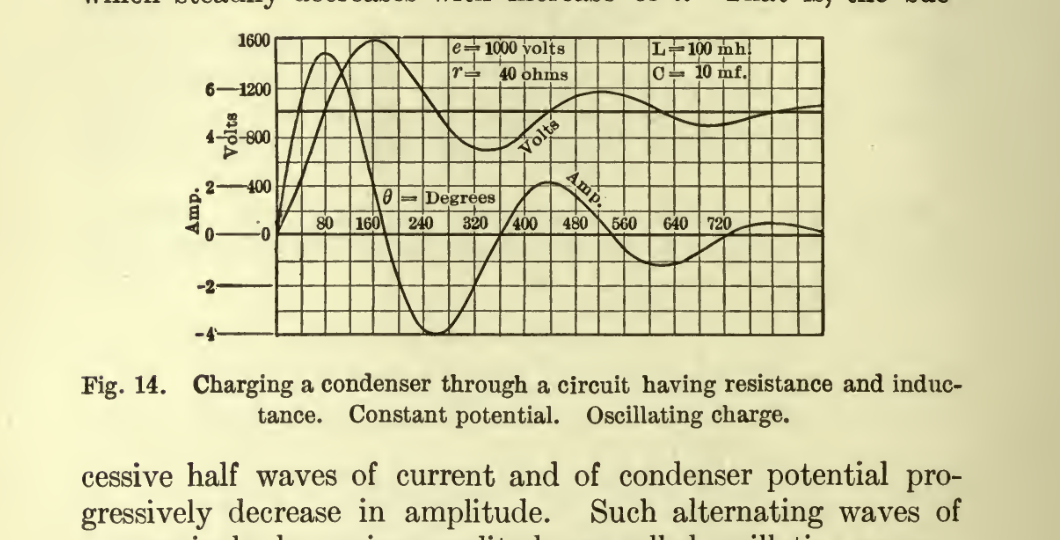
Oscillating condenser charge with successive waves decreasing in amplitude.
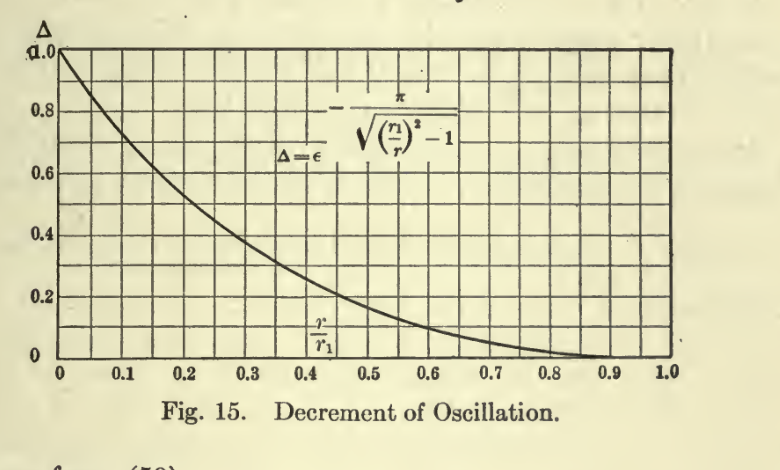
Decrement of oscillation plotted against resistance ratio.
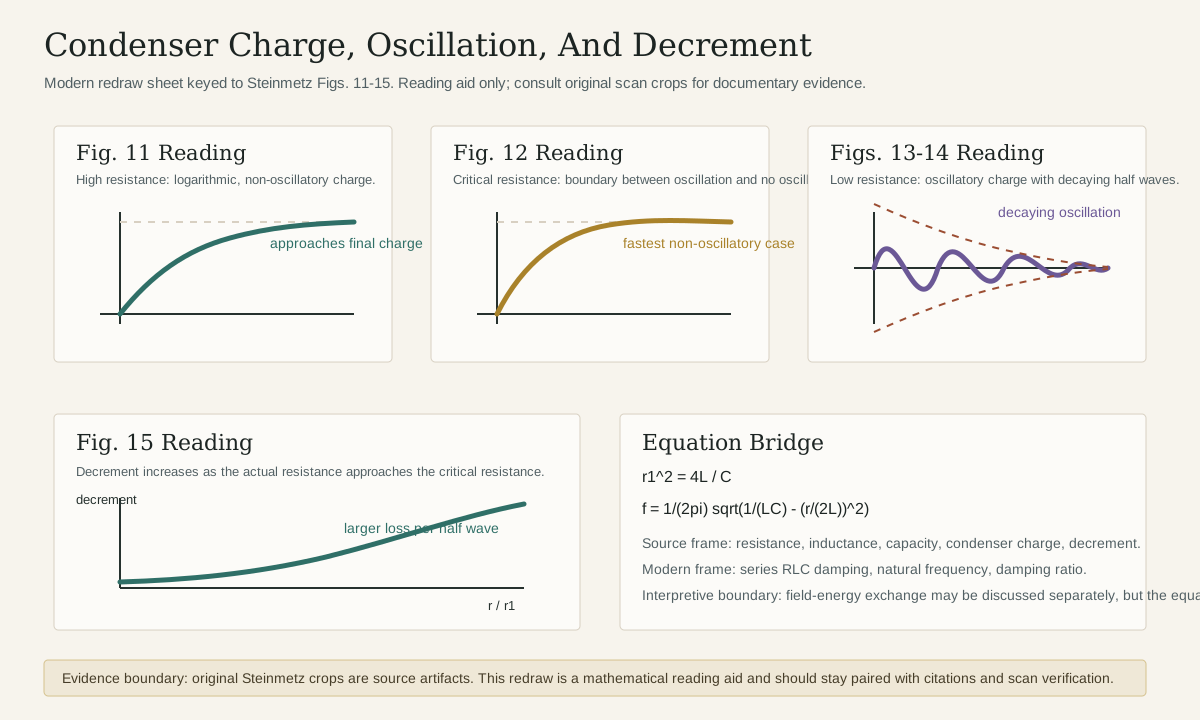
A source-keyed reading aid for logarithmic charge, critical charge, oscillation, and decrement.
Mathematical Spine
Section titled “Mathematical Spine”Steinmetz distinguishes the three cases by the relation between resistance, inductance, and capacity:
In modern language these correspond to non-oscillatory, critical, and oscillatory cases of an RLC transient. The page retains Steinmetz’s historical capacity and condenser language while translating cautiously into modern capacitance language.
Modern Electrical Engineering Interpretation
Section titled “Modern Electrical Engineering Interpretation”This section maps naturally to series RLC transient response:
ris circuit resistance.Lis inductance.Cis electrostatic capacity, modern capacitance.- A high resistance damps oscillation.
- A low resistance allows current and condenser voltage to exchange energy in decaying waves.
- Critical resistance marks the boundary between oscillating and non-oscillating behavior.
Ether-Field Interpretive Reading
Interpretive only: a field-centered reading can describe the condenser and inductance as two storage modes exchanging energy, one electrostatic and one magnetic. Steinmetz’s engineering analysis supports the storage-and-return structure, but any later ether-field ontology remains interpretation unless directly stated by the source.
Hidden Gem
Section titled “Hidden Gem”The source makes the role of resistance visually unavoidable. Resistance is not merely a scalar nuisance in a formula; it decides whether the stored energy exchange dies smoothly, reaches the critical boundary, or overshoots and oscillates.
Still To Verify
Section titled “Still To Verify”- Exact formula transcription from printed pages 52-66.
- Whether this edition’s
mh.andmf.examples should be normalized in captions or preserved as printed. - Relationship between these condenser-discharge cases and Steinmetz’s later surge and transmission-line oscillation chapters.
- Whether the modern redraw sheet needs adjustment after crop-coordinate and full-page review.