AC Phenomena: Symbolic Method
Why This Chapter Matters
Section titled “Why This Chapter Matters”Chapter V is one of the most important mathematical chapters in the whole archive. Steinmetz begins with vector diagrams and then asks for a method that keeps their clarity while giving exact numerical calculation. That is the bridge from hand-drawn phasor geometry to complex-number AC engineering.
The OCR candidate shows a clear sequence:
- Alternating sine waves are represented by vectors.
- Vectors are resolved into rectangular components.
- Components are combined by addition and subtraction.
- A distinguishing symbol
jis introduced for the quadrature component. - Multiplication by
jis interpreted as a 90 degree rotation. - The sine wave becomes a complex quantity.
- Circuit laws are re-expressed in complex form.
Mathematical Spine
Section titled “Mathematical Spine”Steinmetz’s symbolic representation is preserved here in modern typography:
The critical conceptual step is not merely that j^2 = -1. It is that j carries the phase operation: multiplication by j rotates the wave by one quarter period.
From Wave To Circuit
Section titled “From Wave To Circuit”Once a current wave is written as a complex quantity, Steinmetz can write the voltage consumed by resistance and reactance in one expression:
This is the canonical gateway to modern phasor analysis, but the historical page should not flatten the meaning. Resistance is the in-phase, power-consuming part. Reactance is the quadrature part associated with stored and returned energy.
Diagrammatic Reading
Section titled “Diagrammatic Reading”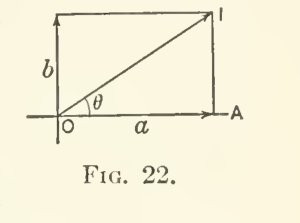
Steinmetz resolves a sine-wave vector into rectangular components.
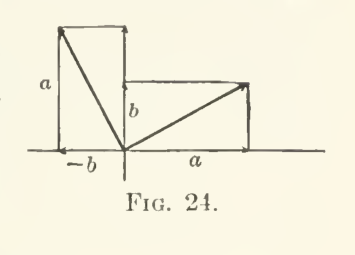
The source figure that ties multiplication by j to one-quarter-period phase rotation.
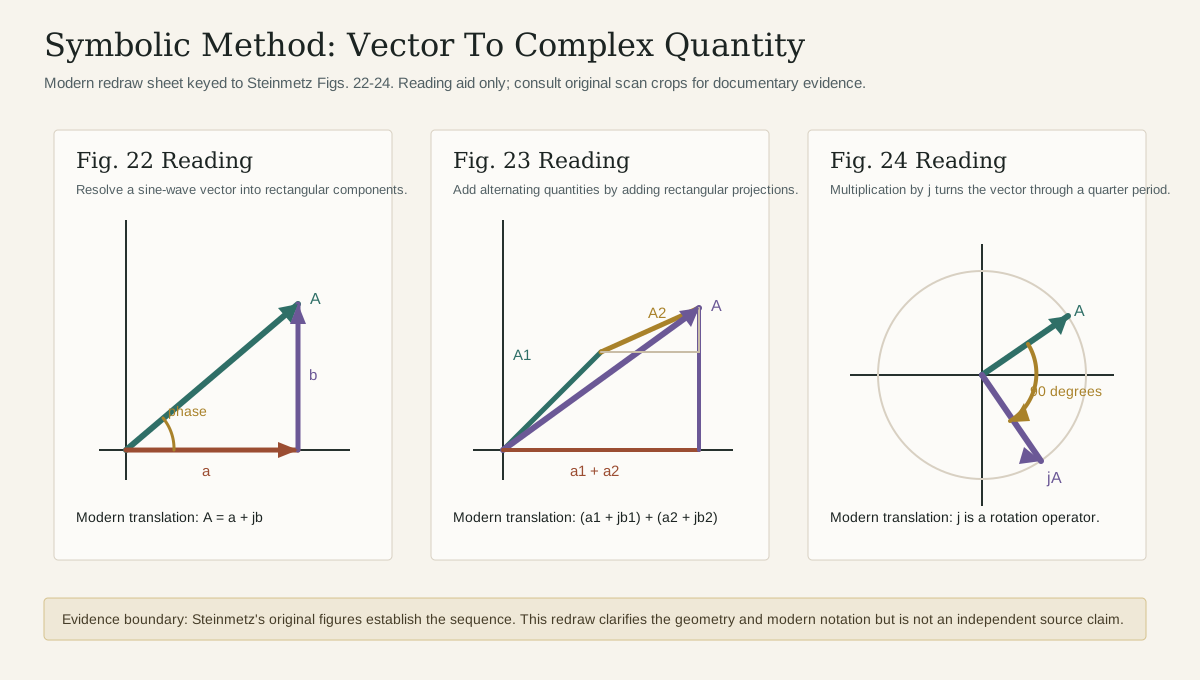
A source-keyed reading aid for rectangular components, resultant addition, and quarter-period rotation.
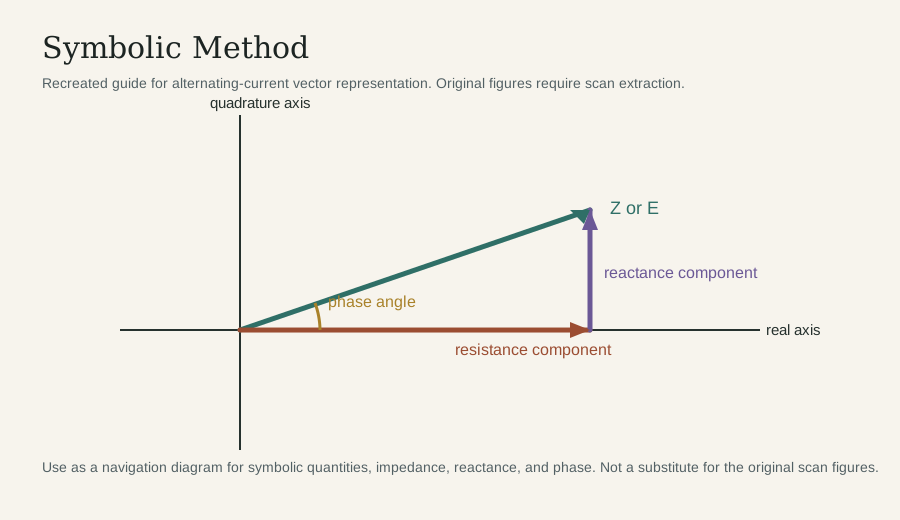
The recreated guide shows how rectangular components become a complex expression.
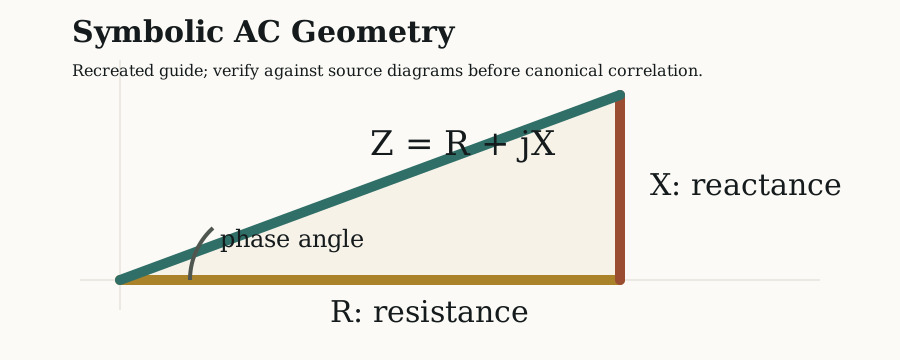
Resistance and reactance become the rectangular components of impedance.
Open the original AC Chapter V figure set
Open the phasor and symbolic form tool
Modern Electrical Engineering Interpretation
This chapter becomes modern phasor analysis. The present-day notation is familiar, but Steinmetz’s route is pedagogically valuable because it starts from waves, phase, and geometry before compressing the result into algebra.
Ether-Field Interpretive Reading
Interpretive only: field-centered readers may treat the quadrature component as preserving a difference between dissipative action and field storage. That is an interpretive reading of the mathematics, not a proof that Steinmetz endorsed a later ether theory.
Links To Build
Section titled “Links To Build”- Symbolic Method
- Complex Quantities
- Symbolic Rectangular Components
- Impedance
- Reactance
- Impedance and Reactance Equation
Verification Tasks
Section titled “Verification Tasks”- Check the OCR around
a + jb,j^2 = -1, andZ = r + jxagainst the scan. - Figs. 21-24 have been extracted as promoted scan crops; next pass should verify crop coordinates against the full page and refine the redraw sheet if the scan review changes the reading.
- Align the Internet Archive edition page numbers with chapter-line references.