Symbolic Method
Steinmetz Usage
Section titled “Steinmetz Usage”The symbolic method is Steinmetz’s complex-number method for representing alternating-current quantities. It makes magnitude and phase calculable in one expression, allowing resistance and reactance, or conductance and susceptance, to become parts of a structured mathematical object.
In the OCR seed for Alternating Current Phenomena, the symbolic method appears near vector representation, resistance, reactance, impedance, capacity reactance, Kirchhoff’s laws, and power representation. That placement tells us how the method functions: it is not an isolated mathematical trick, but the bridge from sinusoidal waves to usable circuit calculation.
Modern Equivalent
Section titled “Modern Equivalent”Modern electrical engineering teaches this as phasor analysis and complex impedance.
where R is resistance and X is reactance.
Diagrammatic Explanation
Section titled “Diagrammatic Explanation”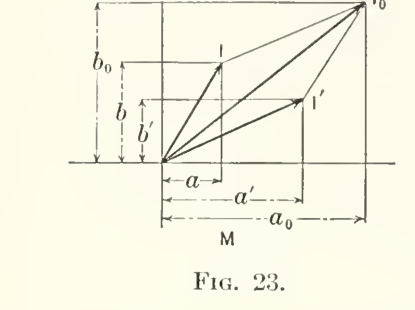
Component addition as the source bridge from vector geometry to symbolic calculation.
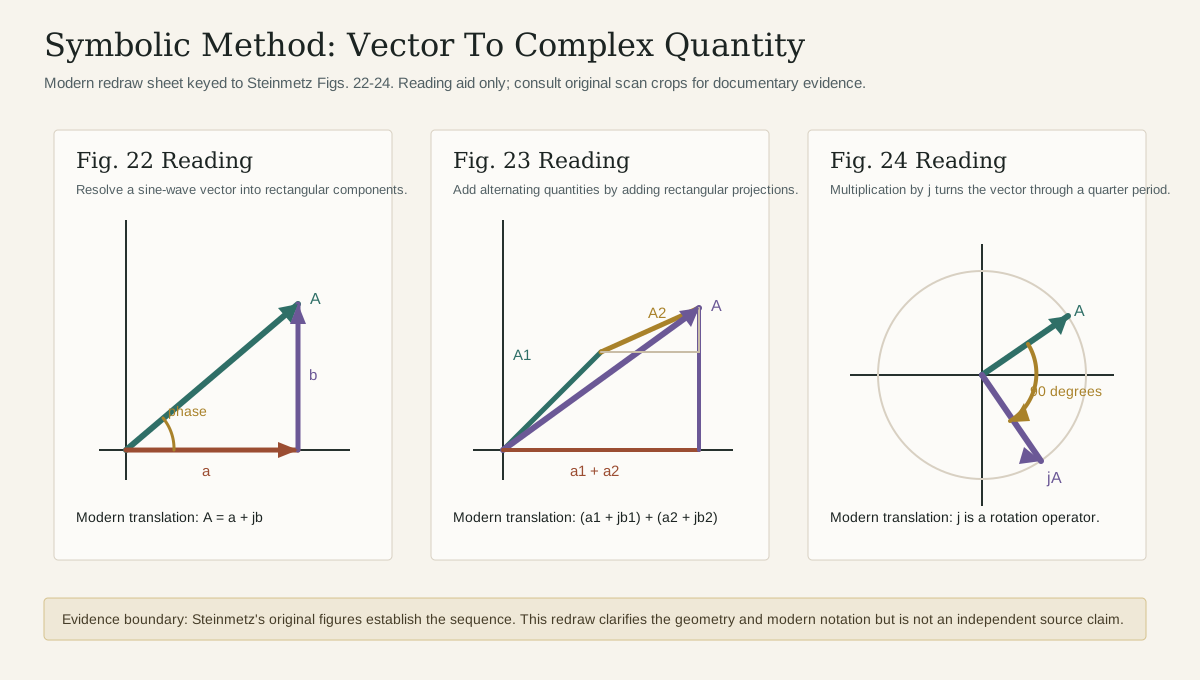
Rectangular components, resultant addition, and quarter-period rotation in one source-keyed guide.
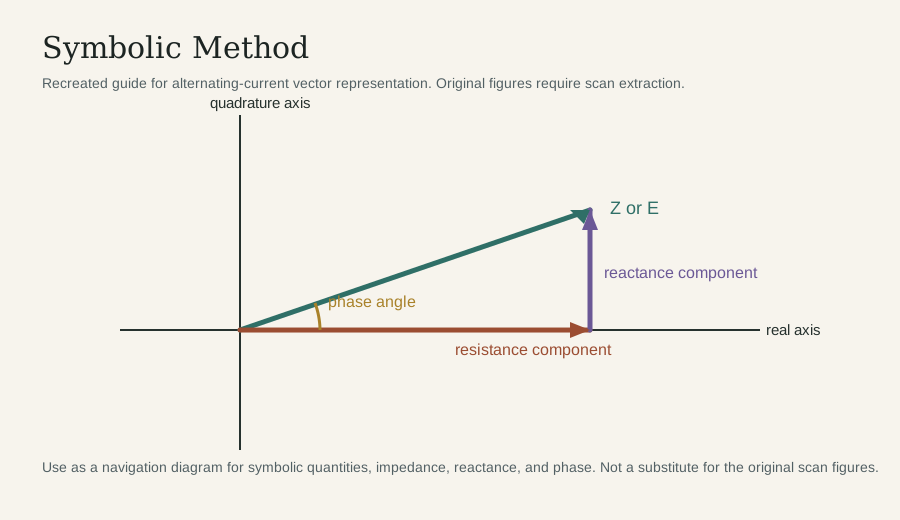
Magnitude and phase as a rotating or projected quantity.
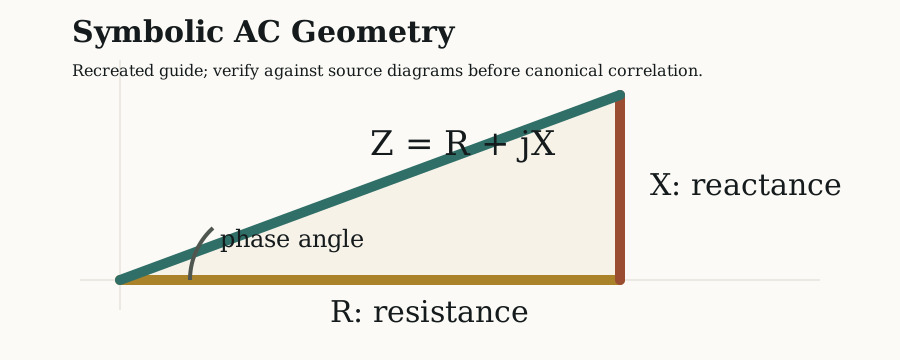
Resistance and reactance as rectangular components of a symbolic quantity.
The phasor and symbolic form tool gives a live version of this same geometry by translating magnitude and phase into a + jb.
Why It Matters
Section titled “Why It Matters”The method is one of Steinmetz’s great acts of engineering translation. It turns periodic electrical motion into stable symbolic structure, making AC systems calculable without losing phase.
Reading Warning
Section titled “Reading Warning”Modern notation can make this look too easy. The archive should keep the physical interpretation visible: resistance corresponds to energy dissipation, while reactance corresponds to periodic energy storage and return. The symbolic method compresses those differences into a form that can be added, resolved, and compared.
Research Tasks
Section titled “Research Tasks”- Verify Steinmetz’s original notation for the imaginary unit and symbolic quantities.
- Compare his terminology with modern phasor notation.
- Link symbolic method pages to impedance, admittance, power factor, and harmonics.
- Verify the modern redraw sheet against crop coordinates and full-page scans.
Source-Grounded Dossier
Section titled “Source-Grounded Dossier”Generated evidence layer: this dossier is built from the processed concept concordance. Counts and snippets are OCR/PDF-text aids, not final quotations. Verify against scans before making exact claims.
Candidate occurrences tracked for this page.
Sources with at least one hit.
Sections, lectures, chapters, or report divisions to review.
What The Current Corpus Shows
Section titled “What The Current Corpus Shows”Read this concept as a mathematical language page: the important work is not only the formulas, but Steinmetz’s translation between rotating vectors, rectangular components, and symbolic calculation.
The strongest current source concentration is Theory and Calculation of Alternating Current Phenomena with 89 candidate hits across 22 sections.
The dossier is meant to turn a concept page into a research workbench: begin with Steinmetz’s source wording, then add modern interpretation, mathematical reconstruction, historical context, and any ether-field reading as separate layers.
Terms And Aliases Tracked
Section titled “Terms And Aliases Tracked”symbolic, symbolic expression, symbolic method, symbolic representation, complex quantities, complex quantity, imaginary quantities, imaginary quantity
Concordance Records
Section titled “Concordance Records”Symbolic Method - Complex Quantities
Source Distribution
Section titled “Source Distribution”| Source | Candidate Hits | Sections | Concepts represented |
|---|---|---|---|
| Theory and Calculation of Alternating Current Phenomena | 89 | 22 | Complex Quantities, Symbolic Method |
| Theory and Calculation of Alternating Current Phenomena | 77 | 22 | Complex Quantities, Symbolic Method |
| Theory and Calculation of Alternating Current Phenomena | 65 | 16 | Complex Quantities, Symbolic Method |
| Theoretical Elements of Electrical Engineering | 24 | 6 | Complex Quantities, Symbolic Method |
| Theory and Calculation of Electric Circuits | 19 | 6 | Complex Quantities, Symbolic Method |
| Theory and Calculation of Transient Electric Phenomena and Oscillations | 16 | 7 | Complex Quantities |
| Engineering Mathematics: A Series of Lectures Delivered at Union College | 12 | 2 | Complex Quantities |
| Theory and Calculation of Electric Apparatus | 6 | 5 | Complex Quantities, Symbolic Method |
Priority Passages To Read
Section titled “Priority Passages To Read”Chapter 5: Symbolic Method - 22 candidate hits
Source: Theory and Calculation of Alternating Current Phenomena (1916)
Location: lines 2760-3266 - Tracked concepts: Complex Quantities, Symbolic Method
Open source text - Open chapter workbench
CHAPTER V SYMBOLIC METHOD 25. The graphical method of representing alternating-current phenomena affords the best means for deriving a clear insight into the mutual relation of the different alternating sine waves entering into the problem. For numerical calculation, however, th ...... ram is shown in Fig. 21. Obviously, no exact numerical values can be taken from a parallelogram as flat as OFiFFo, and from the combination of vectors of the relative magnitudes 1 :6 :100. Hence the importance of the graphical method consists not 30 SYMBOLIC METHOD 31 so much in its usefulness for practical calculation as to aid in the simple understa...Chapter 30: Quartbr-Fhase System - 19 candidate hits
Source: Theory and Calculation of Alternating Current Phenomena (1897)
Location: lines 27501-29124 - Tracked concepts: Complex Quantities, Symbolic Method
Open source text - Open chapter workbench
... .4, a = .1435, a = 8.2°. Impcdarice and Admittance, 283. In complex imaginary quantities, the alternating wave /* '»\ s = £" cos (<^ - cu) is represented by the symbol E - e (cos ci +y sin w) = c^ -\- je^ . By an extension of the meaning of this symbolic ex- pression, the oscillating wave E=^et~^^ cos (<^ - w) can be expressed by the symbol E = e (cos...... . The electromotive force consumed by the inductance L of the circuit, 77 r d I o A- r if f d I Ex = /' - = 2 TT A Z = .V . lit i/<t> ii<t> Hence Ej, = - xit"*'^ {sin (</> - w) + ^ cos (</> - w)} = -- - - -- sin (</> - (u + «)• cos tt Thus, in symbolic expression, ^x = - {- sin (w - a) +ycos (w - a)} dec a COS a = - xi {a -\- J) (cos « + y sin w) dec...Chapter 32: Quarter-Phase System - 19 candidate hits
Source: Theory and Calculation of Alternating Current Phenomena (1900)
Location: lines 25904-27405 - Tracked concepts: Complex Quantities, Symbolic Method
Open source text - Open chapter workbench
... have A = .4, a = .1435, a = 8.2°. Impedance and Admittance. 312. In complex imaginary quantities, the alternating wave * = e cos (* - ffl) is represented by the symbol E = e (cos w -\-j sin w) = <?x -\-jez . By an extension of the meaning of this symbolic ex- pression, the oscillating wave E = ee~a<t> cos (<f> - w) can be expressed by the symbol E = e...... stance r of the circuit ^ The electromotive force consumed by the inductance L of the circuit, Ef**L-~*iNI&t = *-. dt d<$> d<$> Hence Ex = - xif.~a^> (sin (<J> - fy -\- a cos (<£ - w)} xi(.~a^ . ,. „ , N = sin (^> - w -f- a). COS a Thus, in symbolic expression, £x = - °^-{- sin (w - a) +/ cos (w - a)} dec a COS a = - x i (a -f y ) (cos w + 7 sin a>) d...Chapter 5: Symbolic Method - 17 candidate hits
Source: Theory and Calculation of Alternating Current Phenomena (1900)
Location: lines 2322-2773 - Tracked concepts: Complex Quantities, Symbolic Method
Open source text - Open chapter workbench
CHAPTER V. SYMBOLIC METHOD. 23. The graphical method of representing alternating, current phenomena by polar coordinates of time affords the best means for deriving a clear insight into the mutual rela- tion of the different alternating sine waves entering into the problem. For n ...... for definition except that it is not an .ordinary number. 27. A wave of equal intensity, and differing in phase from the wave a + jb by 180°, or one-half period, is repre- sented in polar coordinates by a vector of opposite direction, and denoted by the symbolic expression, - a - jb. Or - Multiplying the symbolic expression, a + jb, of a sine wave by...Chapter 5: Symbouc Mbthod - 16 candidate hits
Source: Theory and Calculation of Alternating Current Phenomena (1897)
Location: lines 2744-3229 - Tracked concepts: Complex Quantities, Symbolic Method
Open source text - Open chapter workbench
... mined analytically by two numerical quanti- ties - the length, Of, or intensity ; and the amplitude, AO/, or phase <o, of the wave, /. Instead of denoting the vector which represents the sine wave in the polar diagram by the polar coordinates. §26] SYMBOLIC METHOD. 35 / and w, we can represent it by its rectangular coordinates, a and b (Fig. 22), wher...... for definition except that it is not an ordinary number. 27. A wave of equal intensity, and differing in phase from the wave a + jb by 180°, or one-half period, is repre- sented in polar coordinates by a vector of opposite direction, and denoted by the symbolic expression, - a - jb. Or - Multiplying the algebraic exprcssiotiy a '\-jby of a sine wave b...Chapter 18: Oscillating Currents - 13 candidate hits
Source: Theory and Calculation of Electric Circuits (1917)
Location: lines 31657-33200 - Tracked concepts: Complex Quantities, Symbolic Method
Open source text - Open chapter workbench
... e have A = 0.4, a = 0.1435, a = 8.2°. Impedance and Admittance 184. In complex imaginary quantities, the alternating wave, z = e cos (0 - 6)^ is represented by the symbol, fl = e(cos d - j sin ^) = ei - je2» By an extension of the meaning of this symbolic expression, the oscillating wave, JS? = tt"*** cos {<t> - 6), can be expressed by the symbol, JjJ...... e then, the e.m.f. consumed by the resistance, r, of the circuit, Er = rl dec a. The e.m.f. consumed due to the inductance, L, of the circuit, n T dl rk TT dl dl Hence E^ = - a;i€-"*{sin (0 - ^) + a cos (0 - ^)} = sm (0 - ^ + a). cos a Thus, in symbolic expression, jFx = I - sin {B - a) - j cos (^ - a) } dec a cos a / ^ \ /I = - xtXa - j) (cos ^ - j s...Reading Layers To Build Out
Section titled “Reading Layers To Build Out”| Layer | What to add next |
|---|---|
| Steinmetz wording | Pull exact source passages only after scan verification; keep OCR text labeled until then. |
| Modern engineering reading | Translate the source usage into present electrical-engineering or physics language without erasing the older vocabulary. |
| Mathematical layer | Link equations, variables, diagrams, and worked examples when the concept has formula candidates. |
| Historical layer | Identify whether the term is still used, renamed, absorbed into modern theory, or historically obsolete. |
| Ether-field interpretation | Keep interpretive readings separate from Steinmetz’s explicit claim and from modern physics. |
| Open questions | Record places where the concordance suggests a lead but the scan or edition has not yet been checked. |
Next Editorial Actions
Section titled “Next Editorial Actions”- Open the highest-priority source-text passages above and verify the wording against scans.
- Promote exact definitions, equations, diagrams, and hidden-gem passages into this page with source references.
- Add related concept links, equation pages, and diagram pages once the evidence is scan checked.
- Keep speculative or Wheeler-style readings in explicitly labeled interpretation blocks.