Oscillation And Damping
Steinmetz Usage
Section titled “Steinmetz Usage”In the transient book, oscillation appears when a circuit has at least two energy-storing constants. Inductance and capacity allow energy to pass back and forth. Resistance damps the motion and dissipates energy.
The OCR candidate around condenser charge and discharge discusses oscillating waves, frequency of oscillation, critical resistance, and decrement.
Source Visual Anchor
Section titled “Source Visual Anchor”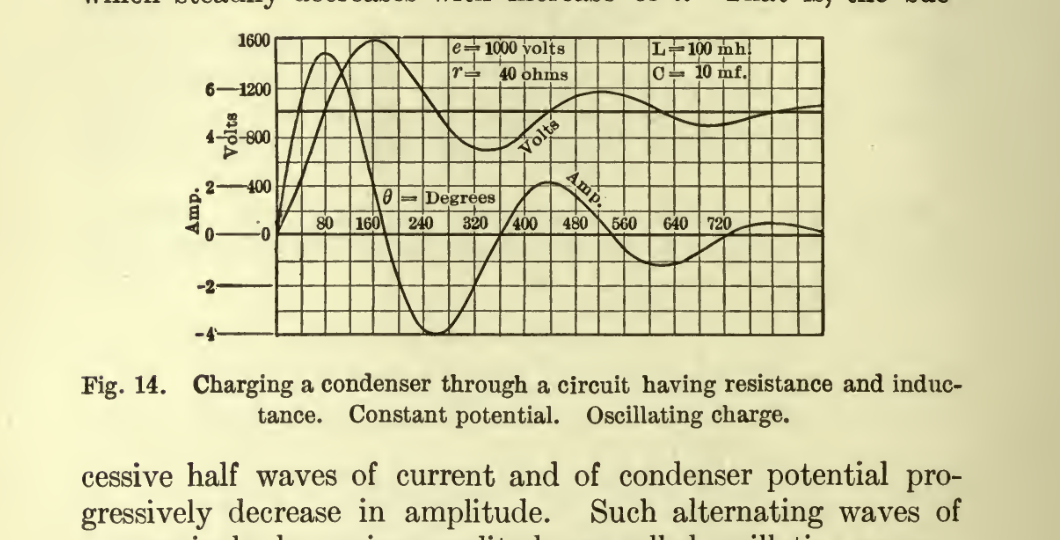
Oscillating condenser charge with decaying current and potential waves.
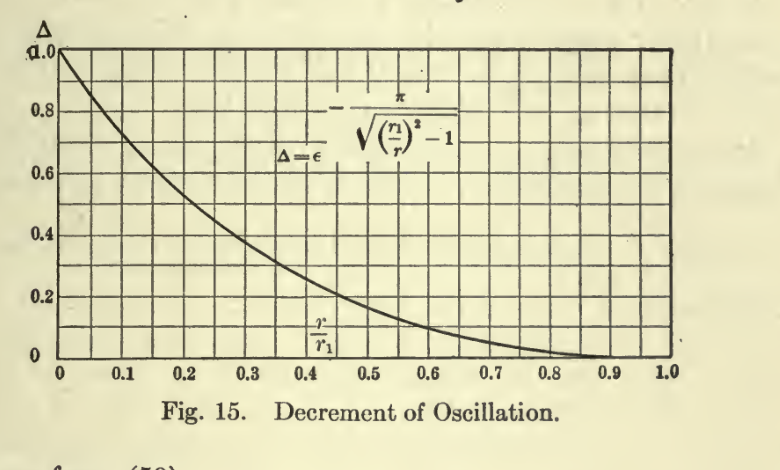
Decrement curve from the condenser charge and discharge section.
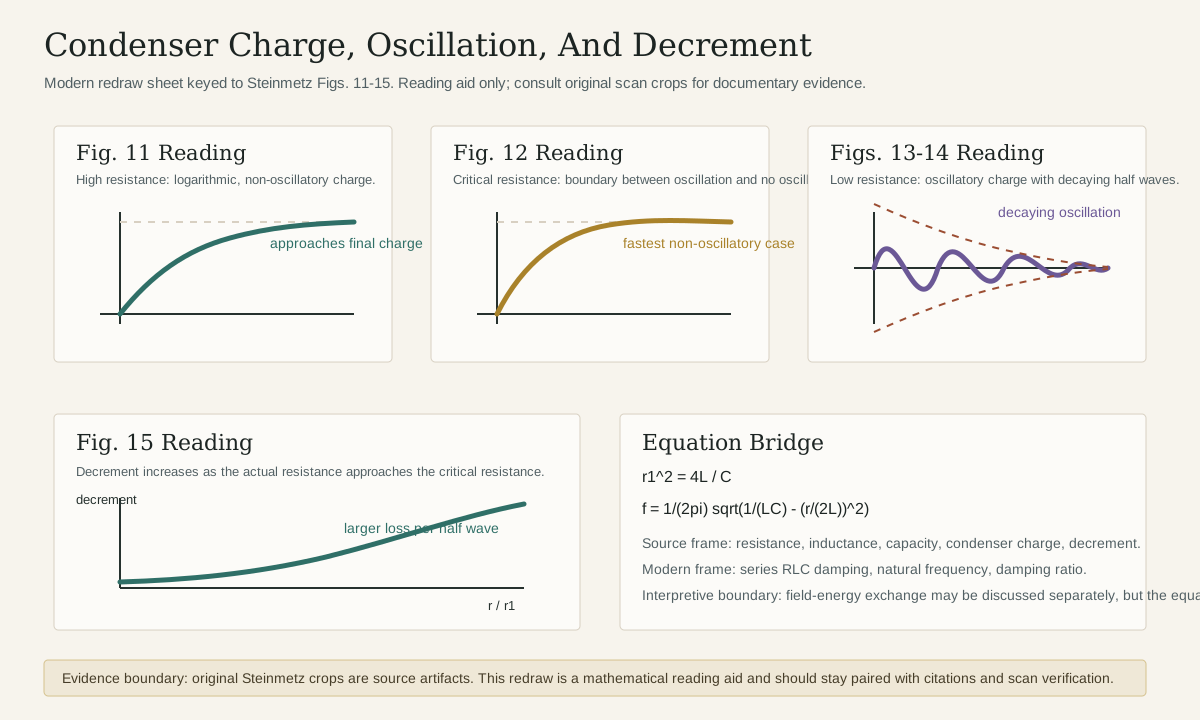
Logarithmic, critical, oscillatory, and decrement cases shown in one source-keyed guide.
Modern Equivalent
Section titled “Modern Equivalent”For an ideal LC circuit:
With resistance included, the response may be underdamped, critically damped, or overdamped.
Interactive Translation
Section titled “Interactive Translation”The archive includes a Transient RLC Response tool that visualizes the same boundary Steinmetz describes in the condenser-discharge section: below critical resistance the potential oscillates and decays, at critical resistance it returns without oscillation as quickly as possible, and above critical resistance it becomes a slower non-oscillatory discharge.
The tool is a modern mathematical translation, not a substitute for the source figures. Read it alongside original Figs. 14 and 15 and the condenser decrement equation page.
Physical Meaning
Section titled “Physical Meaning”Oscillation is not merely a waveform shape. It is an energy process:
- Magnetic energy in inductance.
- Electric energy in capacity.
- Dissipation in resistance.
- Repeated exchange until damping reduces the motion.
Hidden Gem
This concept is a central bridge between Steinmetz, Tesla-era high-frequency work, lightning/surge behavior, and modern RLC theory. It explains why transient analysis often reveals stresses that steady-state analysis hides.
Related Pages
Section titled “Related Pages”- Transient Terms
- Condenser Charge and Discharge
- Condenser Oscillation Equation
- RLC Oscillation Equation
- Distributed Constants
Source-Grounded Dossier
Section titled “Source-Grounded Dossier”Generated evidence layer: this dossier is built from the processed concept concordance. Counts and snippets are OCR/PDF-text aids, not final quotations. Verify against scans before making exact claims.
Candidate occurrences tracked for this page.
Sources with at least one hit.
Sections, lectures, chapters, or report divisions to review.
What The Current Corpus Shows
Section titled “What The Current Corpus Shows”Read this concept page through the linked source passages first. Use the dossier to locate Steinmetz’s wording, then add modern, mathematical, historical, and interpretive layers only with labels.
The strongest current source concentration is Theory and Calculation of Transient Electric Phenomena and Oscillations with 578 candidate hits across 55 sections.
The dossier is meant to turn a concept page into a research workbench: begin with Steinmetz’s source wording, then add modern interpretation, mathematical reconstruction, historical context, and any ether-field reading as separate layers.
Terms And Aliases Tracked
Section titled “Terms And Aliases Tracked”oscillating, oscillation, oscillations, oscillatory, damped, damping, decrement, logarithmic decrement, resonance, resonant
Concordance Records
Section titled “Concordance Records”Oscillation - Damping - Resonance
Source Distribution
Section titled “Source Distribution”| Source | Candidate Hits | Sections | Concepts represented |
|---|---|---|---|
| Theory and Calculation of Transient Electric Phenomena and Oscillations | 578 | 55 | Damping, Oscillation, Resonance |
| Theory and Calculation of Electric Circuits | 233 | 14 | Damping, Oscillation, Resonance |
| Elementary Lectures on Electric Discharges, Waves and Impulses, and Other Transients | 227 | 15 | Damping, Oscillation, Resonance |
| Elementary Lectures on Electric Discharges, Waves and Impulses, and Other Transients | 152 | 12 | Damping, Oscillation, Resonance |
| Theory and Calculation of Alternating Current Phenomena | 112 | 14 | Damping, Oscillation, Resonance |
| General Lectures on Electrical Engineering | 89 | 11 | Damping, Oscillation, Resonance |
| Theory and Calculation of Alternating Current Phenomena | 81 | 10 | Damping, Oscillation, Resonance |
| Theory and Calculation of Electric Apparatus | 38 | 7 | Damping, Oscillation, Resonance |
Priority Passages To Read
Section titled “Priority Passages To Read”Chapter 18: Oscillating Currents - 87 candidate hits
Source: Theory and Calculation of Electric Circuits (1917)
Location: lines 31657-33200 - Tracked concepts: Damping, Oscillation, Resonance
Open source text - Open chapter workbench
CHAPTER XVIII OSCILLATING CURRENTS Introductioii 181. An electric current varying periodically between constant maximum and minimum values - that is, in equal time intervals repeating the same values - is called an alternating current if the arithmetic mean value equals zero; a ...... nts in which the amplitude of each following wave bears to that of the pre- ceding wave a constant ratio. Such currents consist of a series of waves of constant length, decreasing in amplitude, that is, in strength, in constant proportion. They are called oscillating currents in analogy with mechanical oscillations - ^for instance of the pendulum - ^i...Chapter 10: Instability Of Circuits : The Arc - 84 candidate hits
Source: Theory and Calculation of Electric Circuits (1917)
Location: lines 17632-21381 - Tracked concepts: Damping, Oscillation, Resonance
Open source text - Open chapter workbench
... eoretical work has been done, more or less systematically, on transients, and a great mass of information is thus available in the literature. These transients are more ex- tensively treated in "Theory and Calculation of Transient Elec- tric Phenomena and Oscillations," and in " Electric Discharges, Waves and Impulses, '' and therefore will be omitted...... - ^ y' ^ ^ ^ ^ ^ i: Fig. 79. . ia shunted by a condenser, the condenser nmkes the arc unstable and puts it out; the available supply voltage, however, starts it again, and so periodically the arc starts and extinguishes, aa an "oscillating arc." 84. There are certain circuit elements which tend to produce instability, such as arcs, pyroelectric conduc...Chapter 6: Oscillating Currents, - 76 candidate hits
Source: Theory and Calculation of Transient Electric Phenomena and Oscillations (1909)
Location: lines 5312-6797 - Tracked concepts: Damping, Oscillation
Open source text - Open chapter workbench
CHAPTER VI. OSCILLATING CURRENTS, 44. The charge and discharge of a condenser through an inductive circuit produces periodic currents of a frequency depending upon the circuit constants. The range of frequencies which can be produced by electro- dynamic machinery is rather li ...... ything for high frequency, a limit is reached in the frequency available by electrodynamic generation. It becomes of importance, therefore, to investigate whether by the use of the condenser discharge the range of frequencies can be extended. Since the oscillating current approaches the effect of an alternating current only if the damping is small, th...Lecture 10: Continual And Cumulative Oscillations - 75 candidate hits
Source: Elementary Lectures on Electric Discharges, Waves and Impulses, and Other Transients (1914)
Location: lines 6804-8485 - Tracked concepts: Damping, Oscillation, Resonance
Open source text - Open chapter workbench
LECTURE X. CONTINUAL AND CUMULATIVE OSCILLATIONS. 43. A transient is the phenomenon by which the stored energy readjusts itself to a change of circuit conditions. In an oscilla- tory transient, the difference of stored energy of the previous and the after condition of the circuit, at a circuit change, ...... an oscilla- tory transient, the difference of stored energy of the previous and the after condition of the circuit, at a circuit change, oscillates between magnetic and dielectric energy. As there always must be some energy dissipation in the circuit, the oscillating energy of the transient must steadily decline, that is, the transient must die out, a...Chapter 5: Free Oscillations - 74 candidate hits
Source: Theory and Calculation of Transient Electric Phenomena and Oscillations (1909)
Location: lines 31451-32708 - Tracked concepts: Damping, Oscillation
Open source text - Open chapter workbench
CHAPTER V. FREE OSCILLATIONS. 28. The general equations of the electric circuit, (50) and (51), contain eight terms: four waves: two main waves and their reflected waves, and each wave consists of a sine term and a cosine term. The equations contain five constants, namely: the fre ...... rminal condi- tions of the problem. Upon the values of these integration constants C and C' largely depends the difference between the phenomena occurring in electric circuits, as those due to direct currents or pulsating currents, alternating currents, oscillating currents, inductive dis- charges, etc., and the study of the terminal conditions thus i...Chapter 32: Quarter-Phase System - 71 candidate hits
Source: Theory and Calculation of Alternating Current Phenomena (1900)
Location: lines 25904-27405 - Tracked concepts: Damping, Oscillation, Resonance
Open source text - Open chapter workbench
... epresented by the points of half axis OB upwards ; the negative imaginary numbers are represented by the points of half axis OB' downwards ; the complex imaginary numbers are represented by the points outside of the coordinate axes. APPENDIX II. OSCILLATING CURRENTS. INTRODUCTION. 308. An electric current varying periodically between constant maximum...... rents in which the amplitude of each following wave bears to that of the preceding wave a constant ratio. Such currents consist of a series of waves of constant length, decreasing in amplitude, that is in strength, in constant proportion. They are called oscillating currents in analogy with mechanical oscillations, - for instance of the pendu- lum,- i...Reading Layers To Build Out
Section titled “Reading Layers To Build Out”| Layer | What to add next |
|---|---|
| Steinmetz wording | Pull exact source passages only after scan verification; keep OCR text labeled until then. |
| Modern engineering reading | Translate the source usage into present electrical-engineering or physics language without erasing the older vocabulary. |
| Mathematical layer | Link equations, variables, diagrams, and worked examples when the concept has formula candidates. |
| Historical layer | Identify whether the term is still used, renamed, absorbed into modern theory, or historically obsolete. |
| Ether-field interpretation | Keep interpretive readings separate from Steinmetz’s explicit claim and from modern physics. |
| Open questions | Record places where the concordance suggests a lead but the scan or edition has not yet been checked. |
Next Editorial Actions
Section titled “Next Editorial Actions”- Open the highest-priority source-text passages above and verify the wording against scans.
- Promote exact definitions, equations, diagrams, and hidden-gem passages into this page with source references.
- Add related concept links, equation pages, and diagram pages once the evidence is scan checked.
- Keep speculative or Wheeler-style readings in explicitly labeled interpretation blocks.