General Lectures on Electrical Engineering Visual Map
Visual Map
Section titled “Visual Map”Review layer: candidate figure references are OCR/PDF-text leads. Promoted crops are documentary scan crops that still need second-pass bibliographic and crop-coordinate review. Modern guide diagrams are explanatory reconstructions, not historical figure evidence.
0
Promoted original crops.
14
Candidate figure references.
2
Modern guide diagrams keyed here.
134
Formula candidates in the same source.
Read source textOpen the processed text reader for this source.Use chapter workbenchSee figure references beside equations, concepts, and glossary hits.Open formula mapRead the matching source-routed math layer.Open full figure atlasCompare this source against the whole visual candidate layer.
Promoted Original Crops
Section titled “Promoted Original Crops”No promoted original crops are attached to this source yet. Use the figure candidates below as crop targets.
Modern Guide Diagrams Keyed To This Source
Section titled “Modern Guide Diagrams Keyed To This Source”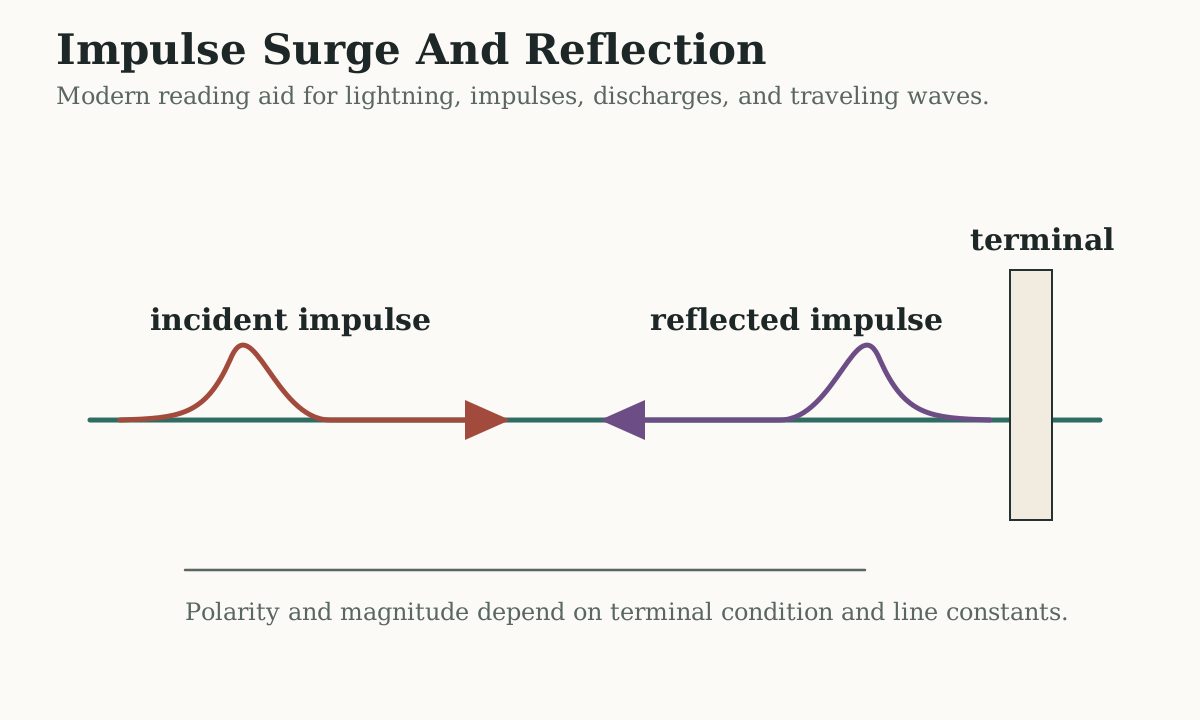
Impulse Surge And Reflection
Modern reading aid for lightning, impulses, discharges, and traveling waves.
lightning-surges, impulse-current, traveling-wave
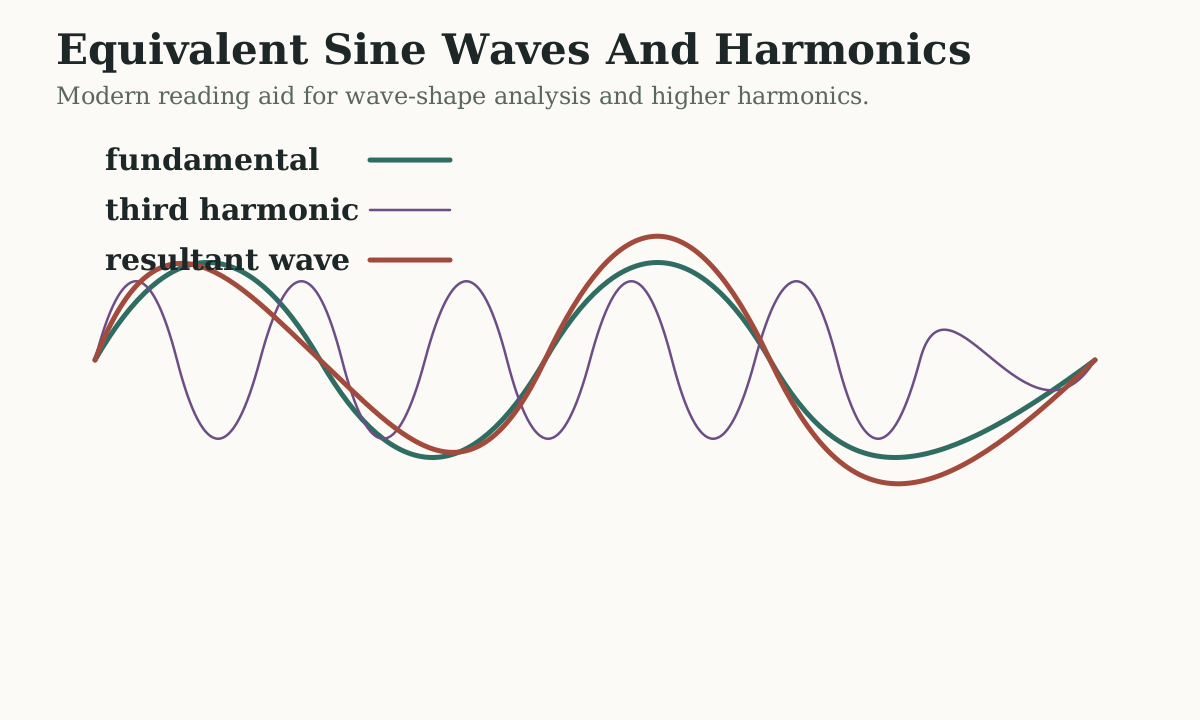
Equivalent Sine Waves And Harmonics
Modern reading aid for wave-shape analysis and higher harmonics.
harmonics, wave-shape, fourier-analysis
Candidate Figure References
Section titled “Candidate Figure References”| Candidate | Caption lead | Section | Routes |
|---|---|---|---|
general-lectures-electrical-engineering-fig-018Fig. 18 | c/ Fig. 18. In Fig. i8 let | Lecture 5: Long Distance Transmission | source workbench |
general-lectures-electrical-engineering-fig-023Fig. 23 | saturation. Fig. 23. In a transformer, e. m. f. and exciting current therefore | Lecture 6: Higher Harmonics Of The Generator Wave | source workbench |
general-lectures-electrical-engineering-fig-024Fig. 24 | ment is now most commonly used. Fig. 24 For direct current distribution in larger cities, such generating stations have practically disappeared, and have been | Lecture 8: Generation | source workbench |
general-lectures-electrical-engineering-fig-027Fig. 27 | ^ Fig. 27 142 - GENERAL LECTURES | Lecture 11: Lightning Protection | source workbench |
general-lectures-electrical-engineering-fig-028Fig. 28 | over a path of zero resistance, Z. On lower voltage, commonly only two resistances are used, one high and one moderately low, as shown by the diagram of a 2000 volt multi-gap arrester. Fig. 28. The resistance of the d… | Lecture 11: Lightning Protection | source workbench |
general-lectures-electrical-engineering-fig-030Fig. 30 | ^ Fig. 30. 2. Acceleration and retardation at two miles per hour per second. Constant speed running between. Fig. 30. Compared | Lecture 12: Electric Railway | source workbench |
general-lectures-electrical-engineering-fig-031Fig. 31 | _ Fig. 31. gram i is shown in the same figure 31, for comparison. As seen, with the lower rate of acceleration, the maximum speed | Lecture 12: Electric Railway | source workbench |
general-lectures-electrical-engineering-fig-032Fig. 32 | ^ g. Fig. 32. mum speed and the lost speed are still greater, that is, the efficiency of the run still lower, and at least 145 seconds | Lecture 12: Electric Railway | source workbench |
general-lectures-electrical-engineering-fig-034Fig. 34 | 1 Fig. 34. with the speed time curves, is much less, and the power con- sumption therefore is less ; that is, the total efficiency is higher. | Lecture 12: Electric Railway | source workbench |
general-lectures-electrical-engineering-fig-035Fig. 35 | B Fig. 35. ELECTRIC RAILWAY | Lecture 12: Electric Railway | source workbench |
general-lectures-electrical-engineering-fig-036Fig. 36 | _ Fig. 36. be impaired again by carrying this too far. Usually the rheostat is all cut out and the acceleration continues on the | Lecture 12: Electric Railway | source workbench |
general-lectures-electrical-engineering-fig-041Fig. 41 | ^_, Fig. 41. MOTOK CHARACTERISTICS 173 | Lecture 13: Electric Railway: Motor Characteristics | source workbench |
general-lectures-electrical-engineering-fig-047Fig. 47 | ^ Fig. 47. seen, below 3.35 amperes, the total required voltage still | Lecture 17: Arc Lighting | source workbench |
general-lectures-electrical-engineering-fig-048Fig. 48 | 48. The primary coil P and the secondary coil S are movable Fig. 48. with regard to each other (which of the two coils is movable, | Lecture 17: Arc Lighting | source workbench |