Theory and Calculation of Electric Apparatus Visual Map
Visual Map
Section titled “Visual Map”Review layer: candidate figure references are OCR/PDF-text leads. Promoted crops are documentary scan crops that still need second-pass bibliographic and crop-coordinate review. Modern guide diagrams are explanatory reconstructions, not historical figure evidence.
Promoted original crops.
Candidate figure references.
Modern guide diagrams keyed here.
Formula candidates in the same source.
Promoted Original Crops
Section titled “Promoted Original Crops”No promoted original crops are attached to this source yet. Use the figure candidates below as crop targets.
Modern Guide Diagrams Keyed To This Source
Section titled “Modern Guide Diagrams Keyed To This Source”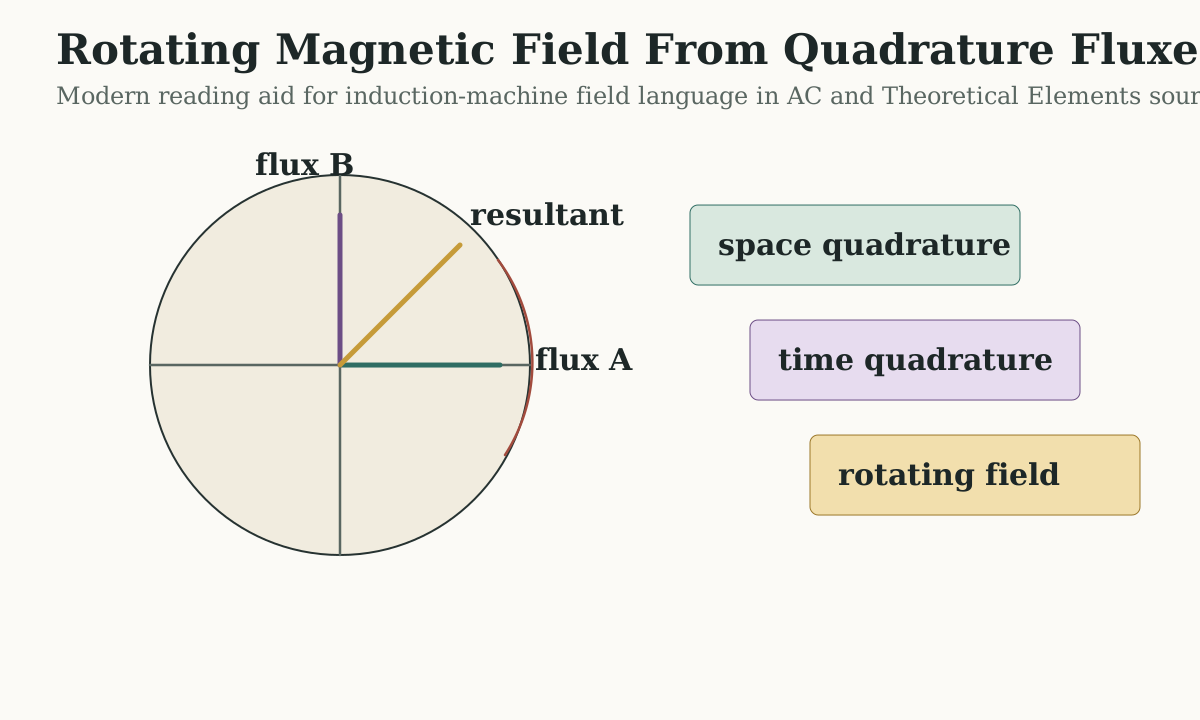
Modern reading aid for induction-machine field language in AC and Theoretical Elements sources.
symbolic-method, magnetism, phase, induction-motor
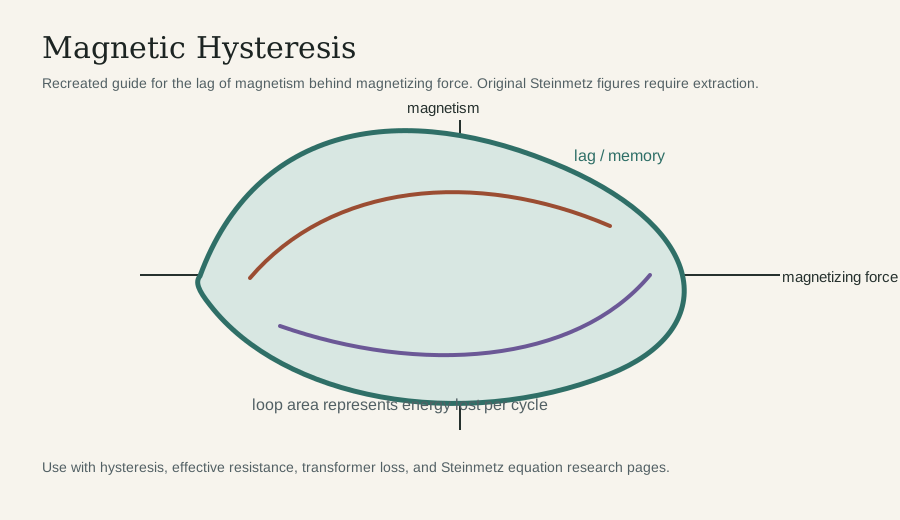
Modern guide for magnetic lag, loop area, and energy loss per cycle.
hysteresis, magnetism, magnetic-loss, effective-resistance
Candidate Figure References
Section titled “Candidate Figure References”| Candidate | Caption lead | Section | Routes |
|---|---|---|---|
theory-calculation-electric-apparatus-fig-022Fig. 22 | nes, the ) parent Fig. 22. INDUCTION MOTOR 67 | Chapter 4: Induction Motor With Secondary Excitation | source workbench |
theory-calculation-electric-apparatus-fig-058Fig. 58 | which represents the current distribution per phase through the air gap of the induction machine, shown by the diagrams F of Fig. 58. The corresponding flux distribution, $, in Fig. 58, expressed by a trignometric ser… | Chapter 7: Higher Harmonics In Induction Motors | source workbench |
theory-calculation-electric-apparatus-fig-068Fig. 68 | In Fig. 68 the drawn tinea correspond to non-inductive bftd The regulation for 45° lagging load is shown by dotted lines in Fig. 68. e’o shows the quadrature component of the monocyclic voltage. e ii, at non-inductive… | Chapter 14: Phase Conversion And Single-Phase Generation | source workbench |
theory-calculation-electric-apparatus-fig-128Fig. 128 | circuitcd turn, S, as shown in Fig. 128, This gives a periodic variation of the effective reluctance, from ft minimum, shown in Fig. 128, to a maximum in the position shown in dotted lines in Fig. 128. This latter str… | Chapter 16: Reaction Machines | source workbench |
theory-calculation-electric-apparatus-fig-151Fig. 151 | P&D Fig. 151. 180. As example are shown, in Fig. 151, with the speed as abscissae, the curves of a single-phase induction motor, having | Chapter 19: Alternating- Current Motors In General | source workbench |
theory-calculation-electric-apparatus-fig-153Fig. 153 | are connected in series to the stator circuits, entirely different Fig. 153. characteristics result, and the motor no more tends to synchronize nor approaches a definite speed at no-load, as a shunt motor, but | Chapter 19: Alternating- Current Motors In General | source workbench |
theory-calculation-electric-apparatus-fig-154Fig. 154 | .8 1.0 1.2 1.4 Fig. 154. 1.6 | Chapter 19: Alternating- Current Motors In General | source workbench |
theory-calculation-electric-apparatus-fig-166Fig. 166 | is less than 90” liehind the primary current, more than 90° ahead of the secondary current, the more so the higher is the inductivity of the secondary circuit, as shown by the transformer diagram, Fig. 166. Herefrom i… | Chapter 20: Single-Phase Commutator Motors | source workbench |
theory-calculation-electric-apparatus-fig-186Fig. 186 | c = c2#2; co#> + #1 = 0; lo = co/i; It = 0. Fig. 186. 7. Series repulsion motor with secondary excitation : | Chapter 20: Single-Phase Commutator Motors | source workbench |
theory-calculation-electric-apparatus-fig-187Fig. 187 | /m Fig. 187. 10. Rotor-excited series motor with conductive compensation : | Chapter 20: Single-Phase Commutator Motors | source workbench |
theory-calculation-electric-apparatus-fig-188Fig. 188 | brush short-circuit c* = 0.04; that is, the same constants as used in the repulsion motor, Fig. 188. Curves are plotted for the voltage ratios; t = 0: inductively compensated series motor, Fig. 189. | Chapter 20: Single-Phase Commutator Motors | source workbench |
theory-calculation-electric-apparatus-fig-192Fig. 192 | t = 0.2: series repulsion motor, high-speed, Fig. 190. ( = 0.5: series repulsion motor, medium-speed, Fig. 191. ( = 1.0: repulsion motor with secondary excitation, low-speed, Fig. 192. e | Chapter 20: Single-Phase Commutator Motors | source workbench |
theory-calculation-electric-apparatus-fig-227Fig. 227 | 262. The unipolar machine may be used :i^ motor as well as generator, and has found some application as motor meter. The general principle of a unipolar meter may be illustrated by Fig. 227. The meter shaft, A , with… | Chapter 22: Unipolar Machines | source workbench |