Theory and Calculation of Electric Circuits Visual Map
Visual Map
Section titled “Visual Map”Review layer: candidate figure references are OCR/PDF-text leads. Promoted crops are documentary scan crops that still need second-pass bibliographic and crop-coordinate review. Modern guide diagrams are explanatory reconstructions, not historical figure evidence.
Promoted original crops.
Candidate figure references.
Modern guide diagrams keyed here.
Formula candidates in the same source.
Promoted Original Crops
Section titled “Promoted Original Crops”No promoted original crops are attached to this source yet. Use the figure candidates below as crop targets.
Modern Guide Diagrams Keyed To This Source
Section titled “Modern Guide Diagrams Keyed To This Source”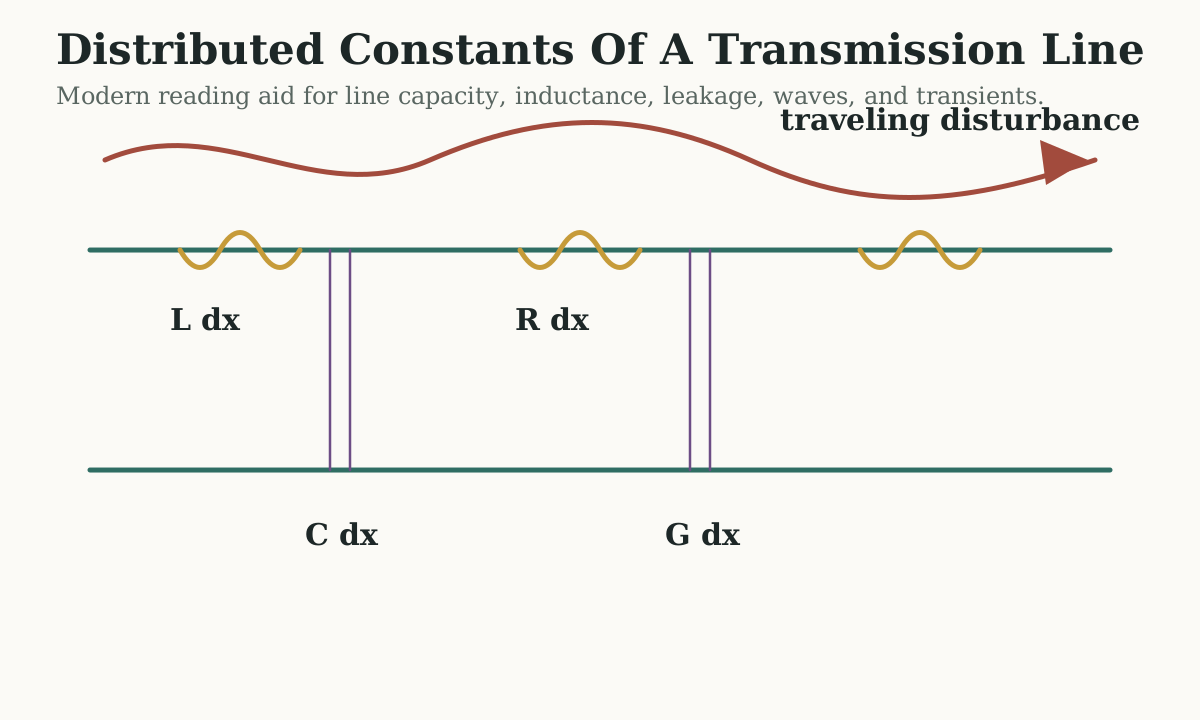
Modern reading aid for line capacity, inductance, leakage, waves, and transients.
distributed-constants, capacity, inductance, waves
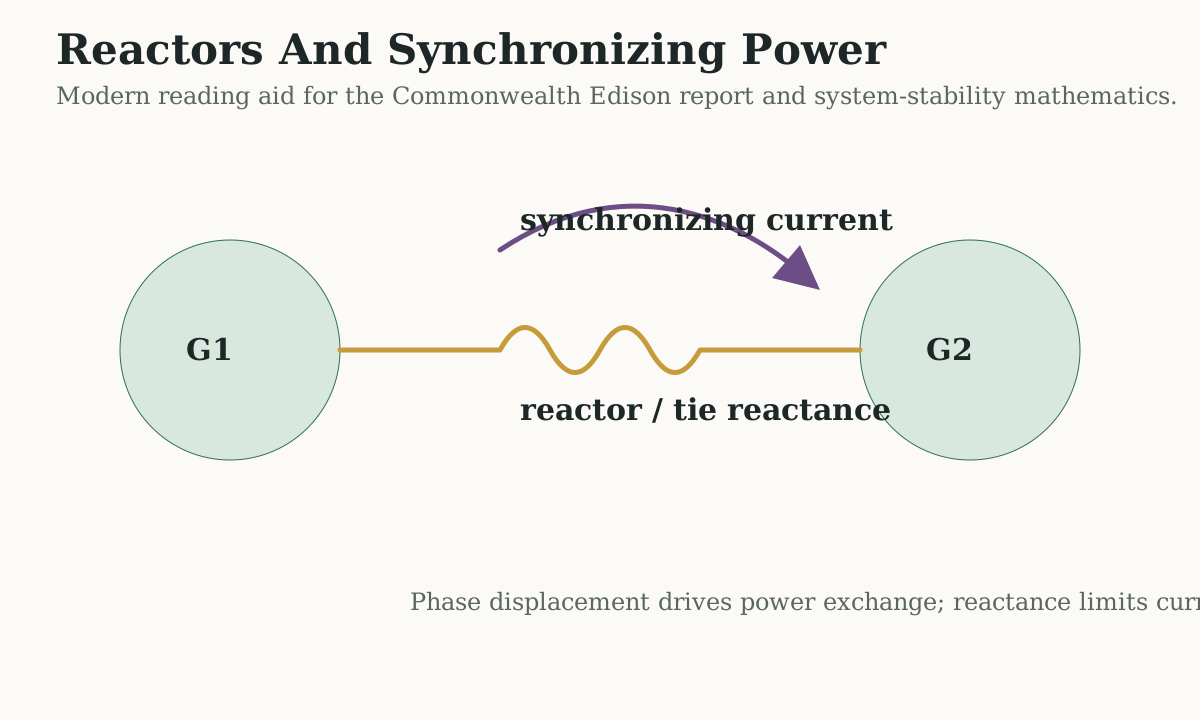
Modern reading aid for the Commonwealth Edison report and system-stability mathematics.
synchronizing-power, power-limiting-reactors, reactance
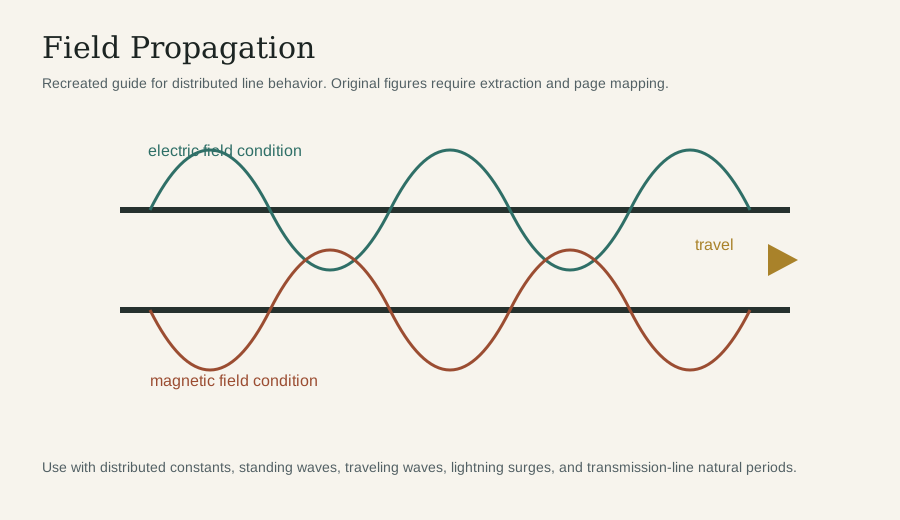
Modern reading aid for distributed constants, standing waves, traveling waves, and surge propagation.
electric-waves, distributed-constants, traveling-wave, lightning-surges
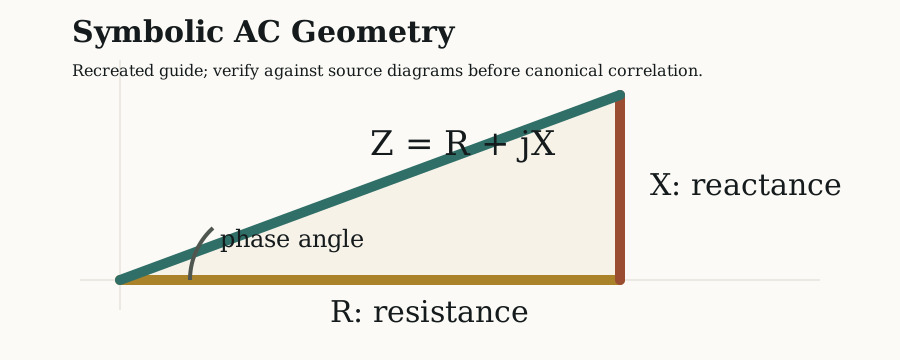
Modern guide for resistance, reactance, impedance, phase angle, and symbolic quantities.
impedance, reactance, power-factor, symbolic-method
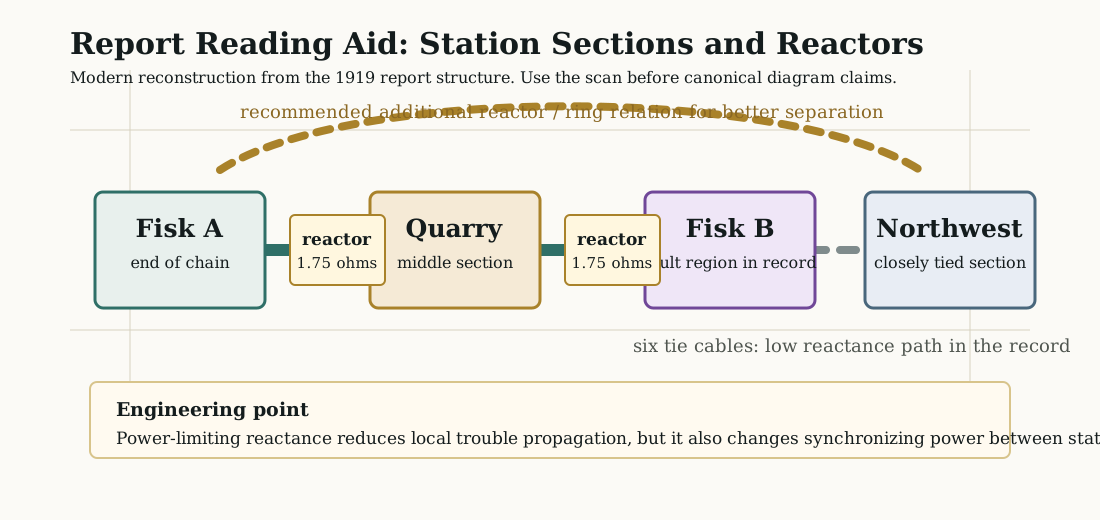
Modern reading aid for station sections, power-limiting reactors, tie cables, and synchronism.
power-limiting-reactors, synchronizing-power, reactance, power-systems
Candidate Figure References
Section titled “Candidate Figure References”| Candidate | Caption lead | Section | Routes |
|---|---|---|---|
theory-calculation-electric-circuits-fig-001Fig. 1 | L Fig. 1. A characteristic of metallic conductoi^ is that the resistance | Chapter 1: Electric Conduction. Soled And Liquid | source workbench |
theory-calculation-electric-circuits-fig-002Fig. 2 | / Fig. 2. ance over a very wide range of temperature is extremely difficult, and often no more accurate. | Chapter 1: Electric Conduction. Soled And Liquid | source workbench |
theory-calculation-electric-circuits-fig-004Fig. 4 | mm Fig. 4. though the temperature coefficient remains negative, like in electrolytic conductors. | Chapter 1: Electric Conduction. Soled And Liquid | source workbench |
theory-calculation-electric-circuits-fig-005Fig. 5 | a Fig. 5. often plotted with -\/i as abscissae, to show the ranges in better | Chapter 1: Electric Conduction. Soled And Liquid | source workbench |
theory-calculation-electric-circuits-fig-010Fig. 10 | M Fig. 10. This, however, still further increases the required voltage and | Chapter 1: Electric Conduction. Soled And Liquid | source workbench |
theory-calculation-electric-circuits-fig-013Fig. 13 | L Fig. 13. ticity, metallic luster, etc., and electrically it has a relatively | Chapter 1: Electric Conduction. Soled And Liquid | source workbench |
theory-calculation-electric-circuits-fig-021Fig. 21 | at low currents the voltage rises again, due to the arc not filling the entire tube. Such a volt-ampere characteristic is given in Fig. 21. 26. Herefrom then follows, that the voltage gradient in the mercury arc, for… | Chapter 2: Electric Conduction. Gas And Vapor | source workbench |
theory-calculation-electric-circuits-fig-031Fig. 31 | (13) Fig. 31. the maximum possible hysteresis loss. | Chapter 4: Magnetism | source workbench |
theory-calculation-electric-circuits-fig-032Fig. 32 | )f Fig. 32. w | Chapter 4: Magnetism | source workbench |
theory-calculation-electric-circuits-fig-034Fig. 34 | s Fig. 34. half-scale, as curve 1, and the magnetization curve of magnetite , FeaO^ — which is about the same as the black scale of iron— ic*. | Chapter 4: Magnetism | source workbench |
theory-calculation-electric-circuits-fig-035Fig. 35 | 3 1 Fig. 35. ^ under the assumption that cither material rigidly follows the 1-8 power law up to the highest densities, by the equation, | Chapter 4: Magnetism | source workbench |
theory-calculation-electric-circuits-fig-045Fig. 45 | density is uniform for the width lo between the coil surfaces, Fig. 45. and then decreases toward the interior of the coils, over the dis- tance K respectively ^, to zero at the coil centers. All the coil | Chapter 6: Magnetism | source workbench |
theory-calculation-electric-circuits-fig-053Fig. 53 | one-half the other. Fig. 53. 61. Distribution of the winding over an arc of the periphery^ o^ | Chapter 7: Shaping Of Waves : General | source workbench |
theory-calculation-electric-circuits-fig-064Fig. 64 | that harmonic n, where n8 = 180**. Fig. 64. If | Chapter 7: Shaping Of Waves : General | source workbench |
theory-calculation-electric-circuits-fig-063Fig. 63 | The magnetic flux wave, B, becomes more and more 9at-topped with increasing saturation, and finally practically rectangular, in Fig. 63. The curves 60 to 63 are drawn with the same maximum values | Chapter 8: Shaping Of Waves By Magnetic Saturation | source workbench |
theory-calculation-electric-circuits-fig-070Fig. 70 | \\ Fig. 70. The enormous reduction of the voltage peak by an air-gap of | Chapter 8: Shaping Of Waves By Magnetic Saturation | source workbench |
theory-calculation-electric-circuits-fig-073Fig. 73 | rmmM Fig. 73. r e | Chapter 9: Wave Screens. Even Harmonics | source workbench |
theory-calculation-electric-circuits-fig-074Fig. 74 | r e Fig. 74. proportional to frequency and voltage, the condenser shimts the | Chapter 9: Wave Screens. Even Harmonics | source workbench |
theory-calculation-electric-circuits-fig-076Fig. 76 | Qii Lnf ggi Fig. 76. where / = frequency of the fundamental wave. | Chapter 9: Wave Screens. Even Harmonics | source workbench |
theory-calculation-electric-circuits-fig-084Fig. 84 | As the two parallel arcs must have the same voltage, the oper- ating point is the point, a, of the intersection of A and -4’ in Fig. 84. The arcs thus would divide the current, each operating at 3 amp. | Chapter 10: Instability Of Circuits : The Arc | source workbench |
theory-calculation-electric-circuits-fig-085Fig. 85 | g Fig. 85. itself; ft and c, however, are unstable. Thus, at the latter points, | Chapter 10: Instability Of Circuits : The Arc | source workbench |
theory-calculation-electric-circuits-fig-086Fig. 86 | 1 Fig. 86. condition of arcs with resistance in series and in shunt, on constant, voltage supply, etc. | Chapter 10: Instability Of Circuits : The Arc | source workbench |
theory-calculation-electric-circuits-fig-087Fig. 87 | branch circuit also must be in phase with each other, that is, the Fig. 87. frequency of the oscillation in Fig. 87 is that at which capacity, C, and inductance, L, balance, or is the resonance frequency. | Chapter 10: Instability Of Circuits : The Arc | source workbench |
theory-calculation-electric-circuits-fig-088Fig. 88 | S~ Fig. 88. the curves of the arc voltage, eo, | Chapter 10: Instability Of Circuits : The Arc | source workbench |
theory-calculation-electric-circuits-fig-089Fig. 89 | SHUNTING ARC Fig. 89. As long as the current in the circuit, A — whether resistance or arc — is steady, no current passes the condenser circuit, and the | Chapter 10: Instability Of Circuits : The Arc | source workbench |
theory-calculation-electric-circuits-fig-094Fig. 94 | of effective resistances, 22, as the values of r-., for pulsations between i + bi and i — bi, and such a curve is shown as R in Fig. 94. We may say, that the arc, when shunted by an oscillating circuit, has an effecti… | Chapter 10: Instability Of Circuits : The Arc | source workbench |
theory-calculation-electric-circuits-fig-006Fig. 6 | I Fig. 06. first increases, but then decreases again, down to zero, so that the cumulative oscillations produced by this arc are self-limitii^, | Chapter 10: Instability Of Circuits : The Arc | source workbench |
theory-calculation-electric-circuits-fig-107Fig. 107 | ^i-1.9 00 - 60°; ^0=7.6. Fig. 107. and the magnetic distribution in the transformer, during the moments marked as a, 6, c, d, e, /, g, in Fig. 107, is shown in | Chapter 12: Reactance Of Induction Apparatus | source workbench |
theory-calculation-electric-circuits-fig-105Fig. 105 | and the magnetic distribution in the transformer, during the moments marked as a, 6, c, d, e, /, g, in Fig. 107, is shown in Fig. 105. In Fig. 105a, the primary flux is larger than the secondary, and all leakage fluxe… | Chapter 12: Reactance Of Induction Apparatus | source workbench |
theory-calculation-electric-circuits-fig-109Fig. 109 | the primary coil equals its resistance drop, eo = roi, then the Fig. 109. voltage across the secondary coil, s, gives the total reactance, x^, for s as primary, | Chapter 12: Reactance Of Induction Apparatus | source workbench |
theory-calculation-electric-circuits-fig-115Fig. 115 | / Fig. 115. give the best regulation; series inductive reactance with an in- ductive, and series condensive reactance with leading current in | Chapter 14: Constant-Potential Constant-Current Trans Formation | source workbench |
theory-calculation-electric-circuits-fig-117Fig. 117 | O < Fig. 117. and the tangent of the primary phase angle | Chapter 14: Constant-Potential Constant-Current Trans Formation | source workbench |
theory-calculation-electric-circuits-fig-119Fig. 119 | square will be more fully discussed. Fig. 119. A. T-Connection or Resonating Circuit | Chapter 14: Constant-Potential Constant-Current Trans Formation | source workbench |
theory-calculation-electric-circuits-fig-123Fig. 123 | 8INQLE-PHA8E Fig. 123. Different arrangements can also be used of the constant-current control, for instance, the inductive and condensive reactances in | Chapter 14: Constant-Potential Constant-Current Trans Formation | source workbench |
theory-calculation-electric-circuits-fig-124Fig. 124 | 8INQIC*PHA8E Fig. 124. the losses in these transformers have not been included, since | Chapter 14: Constant-Potential Constant-Current Trans Formation | source workbench |
theory-calculation-electric-circuits-fig-125Fig. 125 | SINOLE-PHASE Fig. 125. cuits instead of being operated from the three-phase secondaries of the step-down transformers can be operated directly from the | Chapter 14: Constant-Potential Constant-Current Trans Formation | source workbench |
theory-calculation-electric-circuits-fig-127Fig. 127 | That is, the regulation is improved, by the line and leakage reactance, from g = 4 per cent, to 5 = 1.5 per cent, as seen in Fig. 127. 163. In paragraph 161 and the preceding, the shunted react- ances, 61 and 62, have… | Chapter 15: Constant-Voltage Series Operation | source workbench |