Elementary Lectures
Elementary Lectures on Electric Discharges, Waves and Impulses, and Other Transients
This is the primary public scan path for discharge, wave, impulse, and transient-language verification.
sources/elementary-lectures-electric-discharges-waves-impulses/raw/ Open inline scan reader
Read This Source
Section titled “Read This Source”Why This Source Matters
Section titled “Why This Source Matters”This is one of the most important early additions to the archive because it is conceptually close to the user’s core mission: transients, field motion, discharge phenomena, waves, impulses, and the difference between steady-state circuit simplifications and violent short-duration electrical events.
The current archive has copied the local PDF, downloaded the public OCR seed, split the book into lecture candidates, and generated first-pass candidate catalogs. The text is not yet corrected; exact equations and quotations still need scan verification.
This source is especially important because it keeps the archive honest about the difference between steady-state electrical theory and events that are temporary, violent, distributed, or wave-like. Steinmetz’s treatment should become the place where readers can see energy storage, field redistribution, line behavior, and discharge phenomena without flattening them into simple circuit formulas.
Candidate Lecture Map
Section titled “Candidate Lecture Map”- Nature and Origin of Transients
- The Electric Field
- Single-Energy Transients in Continuous Current Circuits
- Single-Energy Transients in Alternating Current Circuits
- Single-Energy Transient of Ironclad Circuit
- Double-Energy Transients
- Double-Energy Transient of Distributed Capacity
- Electric Waves
- Impulse and Impulse Strength
- Oscillating Currents
Concepts to Extract First
Section titled “Concepts to Extract First”- Transient term
- Electric field
- Distributed capacity
- Electric waves
- Oscillation
- Impulse strength
- Discharge
- Damping
- Wave propagation
- Field energy
First Deep-Decoding Page
Section titled “First Deep-Decoding Page”First Decoding Pass
Section titled “First Decoding Pass”Nature and Origin of Transients
The first lecture should establish why a transient exists at all: an electrical system changes state, and stored magnetic or electrostatic energy cannot instantly disappear without a temporary term.
The Electric Field
The second lecture is a priority for the field-language mission. It should be decoded with exact care because it will anchor later comparisons to modern field theory and to labeled ether-field interpretations.
Traveling Waves and Line Oscillations
The line and wave lectures should connect ordinary circuit language to transmission-line behavior, reflection, surge propagation, and the practical danger of high-voltage impulses.
Modern Electrical Engineering Interpretation
This source should become the bridge between classical circuit switching and modern transient analysis. It naturally connects to RLC response, transmission-line behavior, surge protection, high-frequency oscillation, dielectric stress, and lightning/surge phenomena.
Ether-Field Interpretive Reading
Interpretive only: because this book discusses fields, waves, impulses, and discharges, it will likely become one of the main places to compare Steinmetz’s language with field-pressure or dielectric/magnetic interpretive frameworks. No such reading should be treated as historical proof without exact passages.
Visual Guide
Section titled “Visual Guide”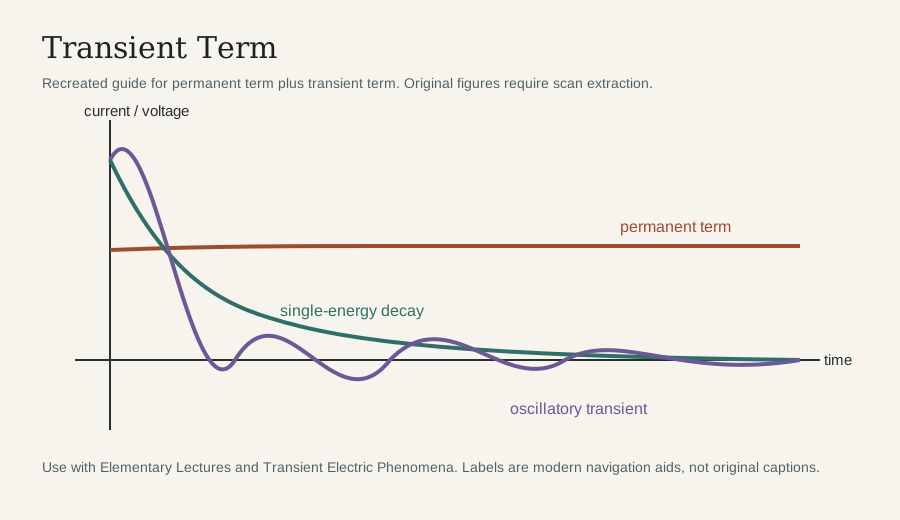
Temporary term, damping, and oscillatory exchange.
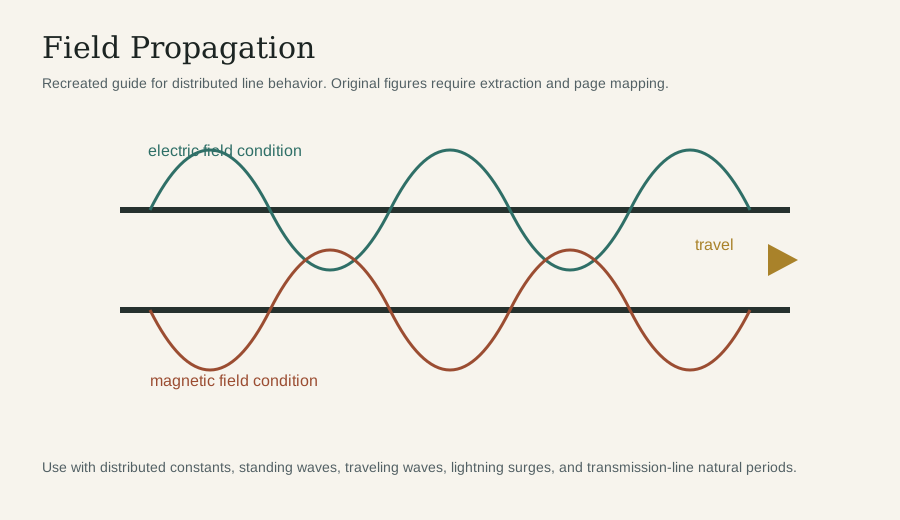
Distributed line behavior and propagation as a field process.
Processing State
Section titled “Processing State”- Structural split: 10 lecture candidates
- Figure candidates: 16
- Equation candidates: 300 capped
- OCR quality: usable for discovery, not canonical for quotation
- Canonical promotion rule: original figures and lecture-opening passages must be checked against the scan before being quoted as final.