Theory and Calculation of Alternating Current Phenomena Visual Map
Visual Map
Section titled “Visual Map”Review layer: candidate figure references are OCR/PDF-text leads. Promoted crops are documentary scan crops that still need second-pass bibliographic and crop-coordinate review. Modern guide diagrams are explanatory reconstructions, not historical figure evidence.
Promoted original crops.
Candidate figure references.
Modern guide diagrams keyed here.
Formula candidates in the same source.
Promoted Original Crops
Section titled “Promoted Original Crops”No promoted original crops are attached to this source yet. Use the figure candidates below as crop targets.
Modern Guide Diagrams Keyed To This Source
Section titled “Modern Guide Diagrams Keyed To This Source”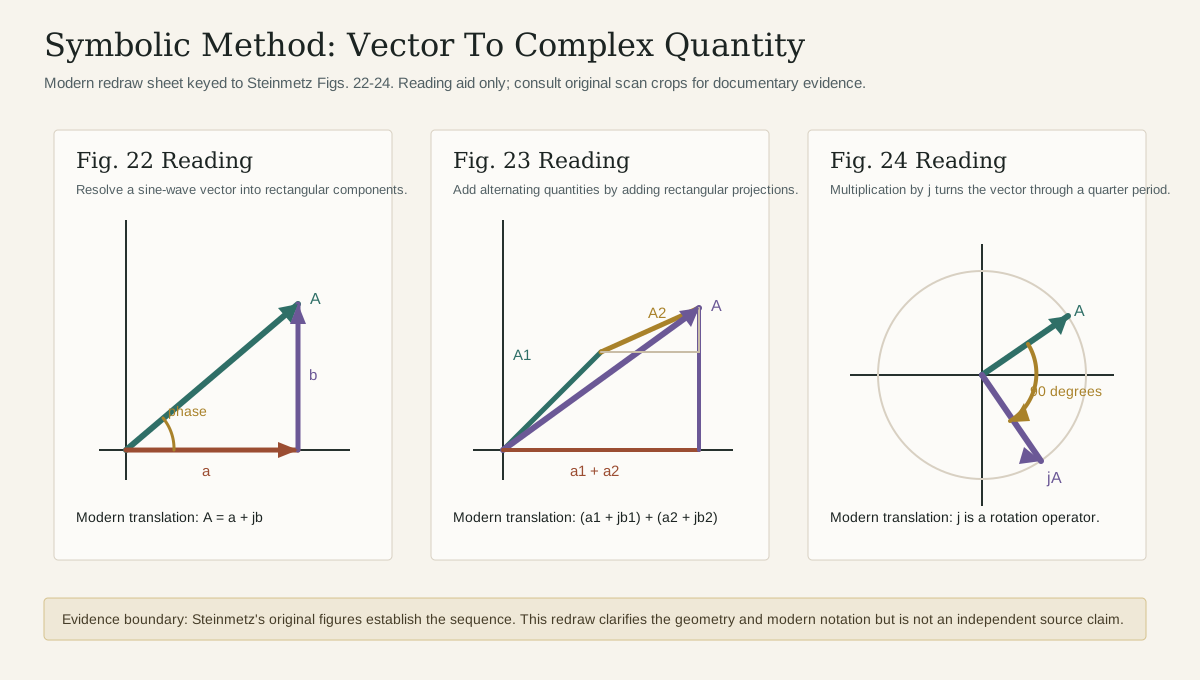
Modern redraw sheet for rectangular components, resultant addition, and quarter-period j rotation.
symbolic-method, complex-quantities, phasor, operator-j
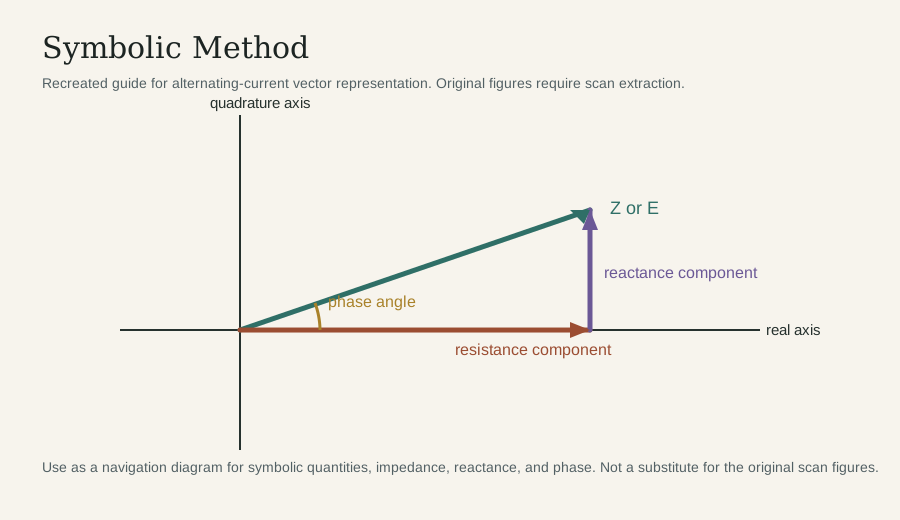
Modern reading aid for vector and complex-number representation of alternating quantities.
symbolic-method, complex-quantities, phase, phasor
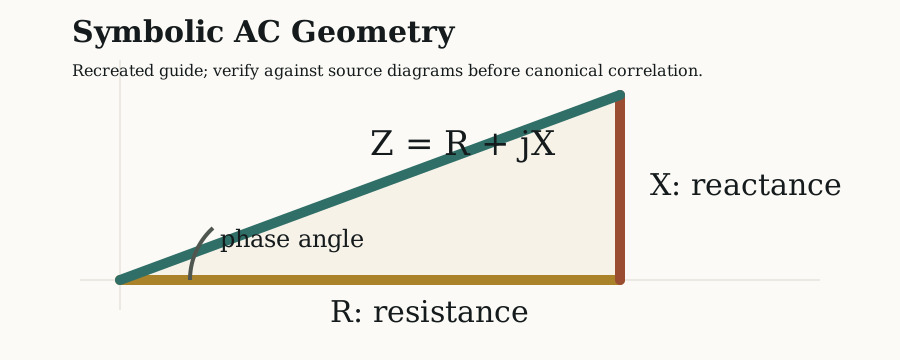
Modern guide for resistance, reactance, impedance, phase angle, and symbolic quantities.
impedance, reactance, power-factor, symbolic-method
Candidate Figure References
Section titled “Candidate Figure References”| Candidate | Caption lead | Section | Routes |
|---|---|---|---|
theory-calculation-alternating-current-phenomena-1897-fig-009Fig. 9 | in the direction of the vector, giving the positive half-wave, Fig. 9. and once in opposition to the vector, giving the negative | Chapter 4: Graphic Befrisxintation | source workbench |
theory-calculation-alternating-current-phenomena-1897-fig-010Fig. 10 | different, they give different polar characteristics. Fig. 10. 15. The sine wave, Fig. 1, is represented in polar | Chapter 4: Graphic Befrisxintation | source workbench |
theory-calculation-alternating-current-phenomena-1897-fig-011Fig. 11 | nates by a vector, which by its length, OC, denotes tlie in- Fig. 11. tensity, and by its amplitude, AOC, the phase, of the sine | Chapter 4: Graphic Befrisxintation | source workbench |
theory-calculation-alternating-current-phenomena-1897-fig-012Fig. 12 | — ~^^E. Fig. 12. volts. What will be the E.M.F. required at the generator end of the line ? | Chapter 4: Graphic Befrisxintation | source workbench |
theory-calculation-alternating-current-phenomena-1897-fig-016Fig. 16 | Eo = V(^ cos a> + Jry + {E^m u> -f Jx)\ Fig. 16. If, however, the current in the receiving circuit is | Chapter 4: Graphic Befrisxintation | source workbench |
theory-calculation-alternating-current-phenomena-1897-fig-077Fig. 77 | non-inductive load it will be lower than when feeding into Fig. 77. a circuit with leading current, as, for instance, a synchro- | Chapter 4: Graphic Befrisxintation | source workbench |
theory-calculation-alternating-current-phenomena-1897-fig-025Fig. 25 | reaction in mechanics. Fig. 25. Further, it is obvious that if in the circuit of a gener- | Chapter 6: Topographic Method | source workbench |
theory-calculation-alternating-current-phenomena-1897-fig-027Fig. 27 | by one-third of a period. Let the RM.Fs. in the direction Fig. 27. from the common connection O of the three branch circuits to the terminals A^, A^f A^, be represented by E-^^ E^, E^. | Chapter 6: Topographic Method | source workbench |
theory-calculation-alternating-current-phenomena-1897-fig-033Fig. 33 | ii Fig. 33. In the same manner, if two branches, E^E^^ and Ei^E^f are loaded, and the third, E^E^, is unloaded, and | Chapter 6: Topographic Method | source workbench |
theory-calculation-alternating-current-phenomena-1897-fig-035Fig. 35 | It is obvious now, since the potential of every point of Fig. 35. the circuit is represented by a point in the topographic | Chapter 6: Topographic Method | source workbench |
theory-calculation-alternating-current-phenomena-1897-fig-038Fig. 38 | m. fig. 38. and the current is, | Chapter 8: Capacity | source workbench |
theory-calculation-alternating-current-phenomena-1897-fig-043Fig. 43 | resofiafice. Fig. 43. Since a synchronous motor in the condition of efficient working acts as a condensance, we get the remarkable result | Chapter 8: Capacity | source workbench |
theory-calculation-alternating-current-phenomena-1897-fig-048Fig. 48 | 3— Fig. 48. Thus we have : — | Chapter 8: Capacity | source workbench |
theory-calculation-alternating-current-phenomena-1897-fig-060Fig. 60 | n\f. 40. Fig. 60. E. | Chapter 8: Capacity | source workbench |
theory-calculation-alternating-current-phenomena-1897-fig-055Fig. 55 | E^y with increasing load. Fig. 55. Let — | Chapter 8: Capacity | source workbench |
theory-calculation-alternating-current-phenomena-1897-fig-081Fig. 81 | iron, to give the same loss of energy through eddy currents. Fig. 81. 02. Demagnetizing^ or screening effect of eddy currents. | Chapter 11: Fouoault Or Eddy 0Ubbent8 | source workbench |
theory-calculation-alternating-current-phenomena-1897-fig-110Fig. 110 | also. Thus, we have, in this case, even on open circuit, no Fig. 110. rotation through a constant magnetic field, but rotation through a pulsating field, which makes the E.M.F. wave | Chapter 16: Aiitebnatingh-Current Osnebator | source workbench |
theory-calculation-alternating-current-phenomena-1897-fig-112Fig. 112 | its maximum while the armature coil still partly faces the Fig. 112. preceding-field pole, as shown in diagram Fig. 112, — it tends | Chapter 16: Aiitebnatingh-Current Osnebator | source workbench |
theory-calculation-alternating-current-phenomena-1897-fig-122Fig. 122 | eral, in one of these diagrams shown in Fig. 122 in drawn Fig. 122. lines, current and E.M.F. are in the same direction, repre- senting mechanical work done by the machine as motor. | Chapter 16: Il | source workbench |
theory-calculation-alternating-current-phenomena-1897-fig-124Fig. 124 | tor diagram in dotted line. Fig. 124. As seen, for small values of E^ the potential drops in the alternator and in the line. For the value of E^ = Eq | Chapter 16: Il | source workbench |
theory-calculation-alternating-current-phenomena-1897-fig-125Fig. 125 | \ X Fig. 125. 180. A. — Constant impressed E.M.F, E^y constant current | Chapter 16: Il | source workbench |
theory-calculation-alternating-current-phenomena-1897-fig-128Fig. 128 | In the first case, Ey^ = E^ (Fig. 127), we see that at Fig. 128. very small curren^, that is very small OE, the current / | Chapter 16: Il | source workbench |
theory-calculation-alternating-current-phenomena-1897-fig-129Fig. 129 | the current can never become zero like in the first case^ Fig. 129. El = E^y but has a minimum value corresponding to the | Chapter 16: Il | source workbench |
theory-calculation-alternating-current-phenomena-1897-fig-130Fig. 130 | :^ Fig. 130. El = Eq at Ei^y and then increases beyond Eq, The cur- | Chapter 16: Il | source workbench |
theory-calculation-alternating-current-phenomena-1897-fig-131Fig. 131 | in Chapter IX. Fig. 131. 183. D. E^ =^ constant ; P ^ constant. | Chapter 16: Il | source workbench |
theory-calculation-alternating-current-phenomena-1897-fig-132Fig. 132 | 8/lti.7 Fig. 132. can be transmitted by the same current / with two different induced RM.Fs. E^ of the motor; one, OEi = EEq small, | Chapter 16: Il | source workbench |
theory-calculation-alternating-current-phenomena-1897-fig-133Fig. 133 | ox Fig. 133. The counter E.M.F. of the motor, Ei, is OEi, equal and parallel EE^y but not shown in the diagrams, to avoid | Chapter 16: Il | source workbench |
theory-calculation-alternating-current-phenomena-1897-fig-136Fig. 136 | «-^iC- — Fig. 136. Fig. 137. | Chapter 16: Il | source workbench |
theory-calculation-alternating-current-phenomena-1897-fig-137Fig. 137 | Fig. 136. Fig. 137. we get | Chapter 16: Il | source workbench |
theory-calculation-alternating-current-phenomena-1897-fig-103Fig. 103 | o E Fig. 103. I | Chapter 23: Generaii Foiitfhase Ststems | source workbench |
theory-calculation-alternating-current-phenomena-1897-fig-104Fig. 104 | I Fig. 104. The different branches of a polyphase system may be either independent from each other, that is, without any | Chapter 23: Generaii Foiitfhase Ststems | source workbench |
theory-calculation-alternating-current-phenomena-1897-fig-165Fig. 165 | four collector rings, as shown diagrammatically in Fig. 165, Fig. 165. is an interlinked system also. The four-wire quarter-phase system produced by a generator with two independent | Chapter 23: Generaii Foiitfhase Ststems | source workbench |