Theory and Calculation of Alternating Current Phenomena Visual Map
Visual Map
Section titled “Visual Map”Review layer: candidate figure references are OCR/PDF-text leads. Promoted crops are documentary scan crops that still need second-pass bibliographic and crop-coordinate review. Modern guide diagrams are explanatory reconstructions, not historical figure evidence.
Promoted original crops.
Candidate figure references.
Modern guide diagrams keyed here.
Formula candidates in the same source.
Promoted Original Crops
Section titled “Promoted Original Crops”No promoted original crops are attached to this source yet. Use the figure candidates below as crop targets.
Modern Guide Diagrams Keyed To This Source
Section titled “Modern Guide Diagrams Keyed To This Source”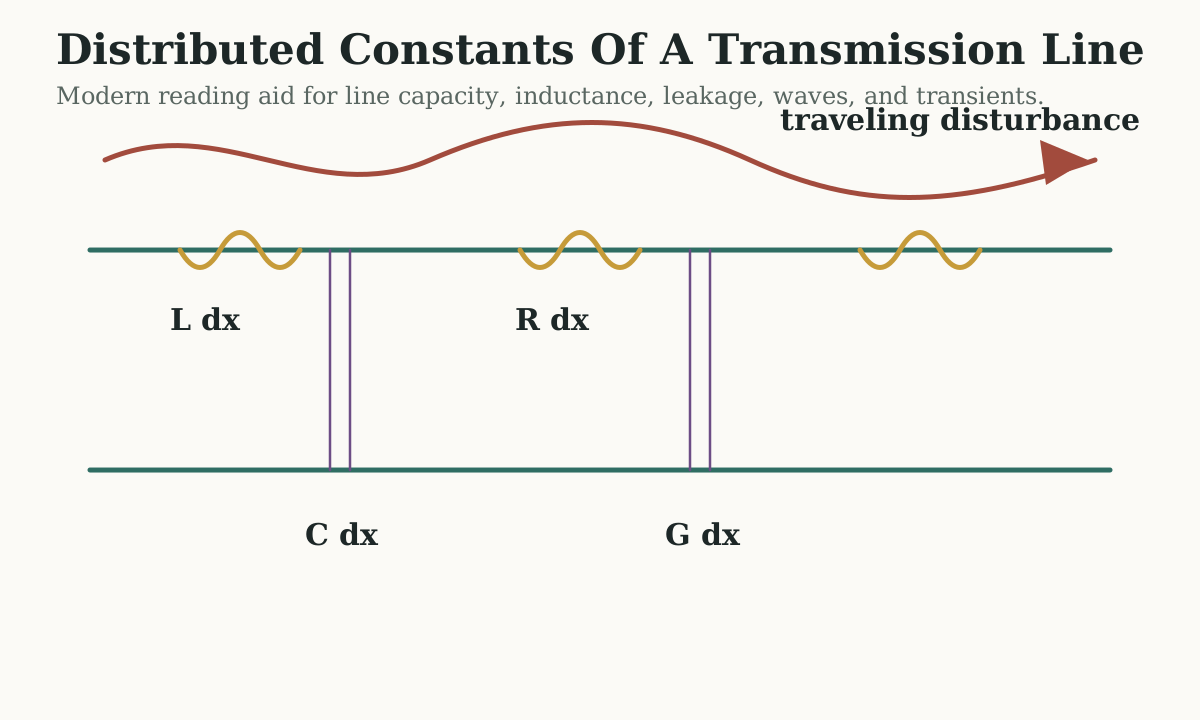
Modern reading aid for line capacity, inductance, leakage, waves, and transients.
distributed-constants, capacity, inductance, waves
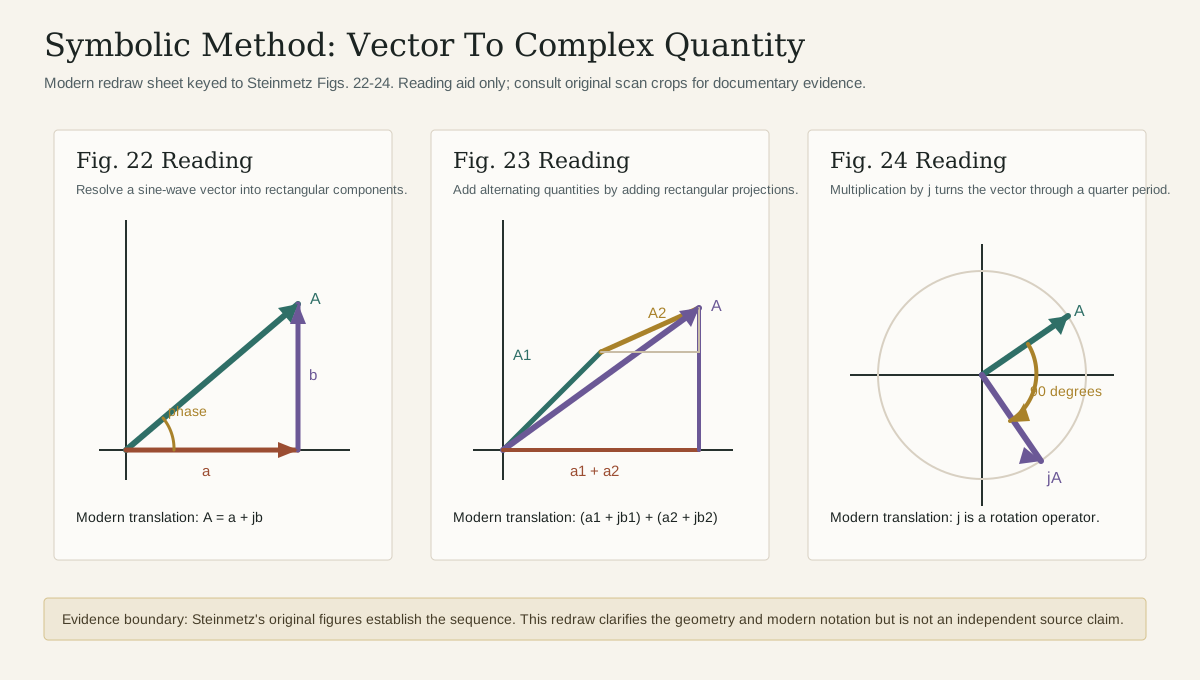
Modern redraw sheet for rectangular components, resultant addition, and quarter-period j rotation.
symbolic-method, complex-quantities, phasor, operator-j
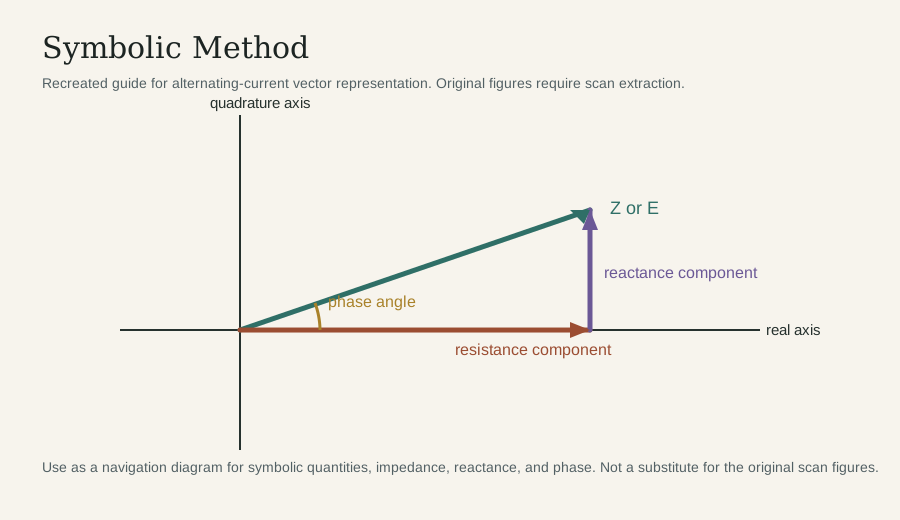
Modern reading aid for vector and complex-number representation of alternating quantities.
symbolic-method, complex-quantities, phase, phasor
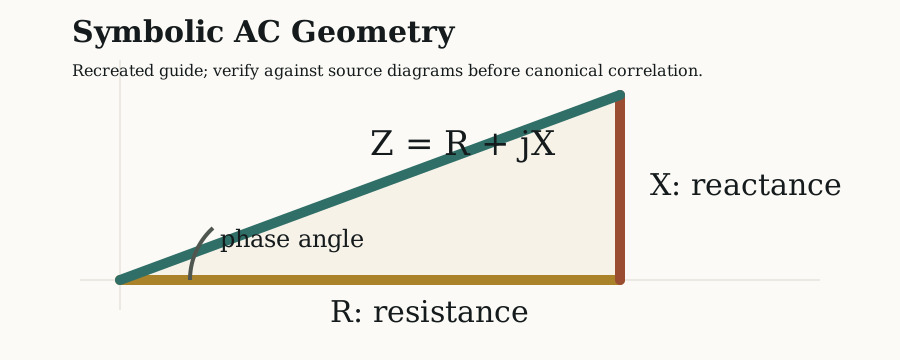
Modern guide for resistance, reactance, impedance, phase angle, and symbolic quantities.
impedance, reactance, power-factor, symbolic-method
Candidate Figure References
Section titled “Candidate Figure References”| Candidate | Caption lead | Section | Routes |
|---|---|---|---|
theory-calculation-alternating-current-phenomena-1900-fig-008Fig. 8 | mum value is found in the following way : — Fig. 8. Let, in Fig. 6, AOB represent a quadrant of a circle with radius 1. | Chapter 2: Instantaneous Values And Integral Values | source workbench |
theory-calculation-alternating-current-phenomena-1900-fig-007Fig. 7 | found in the following way : Fig. 7. Let, in Fig. 7, AOB represent a quadrant of a circle | Chapter 2: Instantaneous Values And Integral Values | source workbench |
theory-calculation-alternating-current-phenomena-1900-fig-011Fig. 11 | nates by a vector, which by its length, OC, denotes the in- Fig. 11. tensity, and by its amplitude, AOC, the phase, of the sine | Chapter 4: Graphic Representation | source workbench |
theory-calculation-alternating-current-phenomena-1900-fig-012Fig. 12 | be sent into a non-inductive circuit at an E.M.F. of E Fig. 12. volts. What will be the E.M.F. required at the generator end of the line ? | Chapter 4: Graphic Representation | source workbench |
theory-calculation-alternating-current-phenomena-1900-fig-013Fig. 13 | E? 0 Fig. 13. 18. We may, however, introduce the effect of the induc- | Chapter 4: Graphic Representation | source workbench |
theory-calculation-alternating-current-phenomena-1900-fig-014Fig. 14 | E.V o Fig. 14. of the impressed E.M.F., in the latter case being of opposite phase. According to the nature of the problem, either the | Chapter 4: Graphic Representation | source workbench |
theory-calculation-alternating-current-phenomena-1900-fig-015Fig. 15 | —X« Fig. 15. 19. Coming back to the equation found for the E.M.F. | Chapter 4: Graphic Representation | source workbench |
theory-calculation-alternating-current-phenomena-1900-fig-018Fig. 18 | E0 = V(^ cos w + Ir)2 -f- (E sin w + Ix)z. Fig. 18. If, however, the current in the receiving circuit is leading, as -is the case when feeding condensers or syn- | Chapter 4: Graphic Representation | source workbench |
theory-calculation-alternating-current-phenomena-1900-fig-017Fig. 17 | ’E. Fig. 17. a circuit with leading current, as, for instance, a synchro- nous motor circuit under the circumstances stated above. | Chapter 4: Graphic Representation | source workbench |
theory-calculation-alternating-current-phenomena-1900-fig-020Fig. 20 | same E.M.F. and current ; or conversely, at a given primary Fig. 20. impressed E.M.F., E0, the secondary E.M.F., E^ will be smaller with an inductive, and larger with a condenser | Chapter 4: Graphic Representation | source workbench |
theory-calculation-alternating-current-phenomena-1900-fig-021Fig. 21 | ever, this becomes too complicated, as will be seen by trying Fig. 21. to calculate, from the above transformer diagram, the ratio of transformation. The primary M.M.F. is given by the | Chapter 5: Symbolic Method | source workbench |
theory-calculation-alternating-current-phenomena-1900-fig-022Fig. 22 | the graphical representation. Fig. 22. 25. We have seen that the alternating sine wave is represented in intensity, as well as phase, by a vector, Of, | Chapter 5: Symbolic Method | source workbench |
theory-calculation-alternating-current-phenomena-1900-fig-024Fig. 24 | riod ; tJiat is, retarding the wave through one-quarter period. Fig. 24. Similarly, — | Chapter 5: Symbolic Method | source workbench |
theory-calculation-alternating-current-phenomena-1900-fig-028Fig. 28 | -*’ Fig. 28. 34. Let, for instance, in Fig. 27, an interlinked three- phase system be represented diagrammatically, as consist- | Chapter 6: Topographic Method | source workbench |
theory-calculation-alternating-current-phenomena-1900-fig-027Fig. 27 | by one-third of a period. Let the E.M.Fs. in the direction Fig. 27 from the common connection O of the three branch circuits | Chapter 6: Topographic Method | source workbench |
theory-calculation-alternating-current-phenomena-1900-fig-029Fig. 29 | E° Fig. 29. E.M.Fs., these currents are represented in Fig. 29 by the | Chapter 6: Topographic Method | source workbench |
theory-calculation-alternating-current-phenomena-1900-fig-031Fig. 31 | •I, Fig. 31. Fig. 32. | Chapter 6: Topographic Method | source workbench |
theory-calculation-alternating-current-phenomena-1900-fig-032Fig. 32 | Fig. 31. Fig. 32. As seen, the induced generator E.M.F. and thus the | Chapter 6: Topographic Method | source workbench |
theory-calculation-alternating-current-phenomena-1900-fig-034Fig. 34 | 90° LAO Fig. 34. Only the circuit characteristics of the first phase are shown as ^ and z’r As seen, passing from the receiving | Chapter 6: Topographic Method | source workbench |
theory-calculation-alternating-current-phenomena-1900-fig-035Fig. 35 | RESISTANCE AND LEAKAGE Fig. 35. current alternately rise and fall, while their phase angle | Chapter 6: Topographic Method | source workbench |
theory-calculation-alternating-current-phenomena-1900-fig-038Fig. 38 | Er Er0 Fig. 38. and the current is, /= | Chapter 8: Circuits Containing Resistance, Inductance, And Capacity | source workbench |
theory-calculation-alternating-current-phenomena-1900-fig-039Fig. 39 | E Fig. 39. Z-jx0 r—j(x + x0}‘ | Chapter 8: Circuits Containing Resistance, Inductance, And Capacity | source workbench |
theory-calculation-alternating-current-phenomena-1900-fig-040Fig. 40 | of reactance in series in a non-inductive circuit is, for small Fig. 40. values of reactance, independent of the sign, but propor- | Chapter 8: Circuits Containing Resistance, Inductance, And Capacity | source workbench |
theory-calculation-alternating-current-phenomena-1900-fig-041Fig. 41 | -t-CONDENSANCE Fig. 41. E0 = 100 volts, and the following conditions of receiver circuit •— z= 1 Qj r = 1>0> x= 0 (Curve j) | Chapter 8: Circuits Containing Resistance, Inductance, And Capacity | source workbench |
theory-calculation-alternating-current-phenomena-1900-fig-042Fig. 42 | series reactance continues up to x0 = il.6, or, x0 = — %x, Fig. 42. where E = 100 volts again ; and for x0 > 1.6 the voltage drops again. | Chapter 8: Circuits Containing Resistance, Inductance, And Capacity | source workbench |
theory-calculation-alternating-current-phenomena-1900-fig-043Fig. 43 | \ Fig. 43. Since a synchronous motor in the condition of efficient working acts as a condensance, we get the remarkable result | Chapter 8: Circuits Containing Resistance, Inductance, And Capacity | source workbench |
theory-calculation-alternating-current-phenomena-1900-fig-044Fig. 44 | x0 = 3.2 (Curve VI.) Fig. 44. Since z = 1.0, the current, /, in all these diagrams has the same value as E. | Chapter 8: Circuits Containing Resistance, Inductance, And Capacity | source workbench |
theory-calculation-alternating-current-phenomena-1900-fig-049Fig. 49 | tance factor, *0/r0, of the series impedance. Fig. 49. ”o | Chapter 8: Circuits Containing Resistance, Inductance, And Capacity | source workbench |
theory-calculation-alternating-current-phenomena-1900-fig-050Fig. 50 | ”o Fig. 50. 50. As an example, Fig. 48 shows the E.M.F., E, | Chapter 8: Circuits Containing Resistance, Inductance, And Capacity | source workbench |
theory-calculation-alternating-current-phenomena-1900-fig-051Fig. 51 | as functions of the reactance, x, of the receiver circuit. Fig. 51. Figs. 49 to 51 give the polar diagram for E0 = 100, x = .95, x = 0, x = - .95, and Z0 = .3 -/ .4. | Chapter 8: Circuits Containing Resistance, Inductance, And Capacity | source workbench |
theory-calculation-alternating-current-phenomena-1900-fig-052Fig. 52 | tance,— that is, of the power consumed in the receiver Fig. 52. circuit, which in this case approaches the conditions of a | Chapter 8: Circuits Containing Resistance, Inductance, And Capacity | source workbench |
theory-calculation-alternating-current-phenomena-1900-fig-054Fig. 54 | JO 190 200 OHMS Fig. 54. In Fig. 54 are shown the values of /, 71} 70, 7f, in Curves I., II., III., IV., similarly as in Fig. 50, for E0 = 1000 volts, | Chapter 8: Circuits Containing Resistance, Inductance, And Capacity | source workbench |
theory-calculation-alternating-current-phenomena-1900-fig-055Fig. 55 | E0, with increasing load. Fig. 55. Let — | Chapter 8: Circuits Containing Resistance, Inductance, And Capacity | source workbench |
theory-calculation-alternating-current-phenomena-1900-fig-081Fig. 81 | as shown in Fig. 81. Fig. 81. 92. Demagnetizing, or screening effect of eddy currents. | Chapter 11: Foucault Or Eddy Currents | source workbench |
theory-calculation-alternating-current-phenomena-1900-fig-082Fig. 82 | where / = total current in conductor. Fig. 82. The magnetic reluctance of a tubular zone of unit length | Chapter 11: Foucault Or Eddy Currents | source workbench |
theory-calculation-alternating-current-phenomena-1900-fig-086Fig. 86 | i Fig. 86. DISTRIBUTED CAPACITY. 173 | Chapter 13: Distributed Capacity, Inductance, Resistance, And Leakage | source workbench |
theory-calculation-alternating-current-phenomena-1900-fig-088Fig. 88 | V Fig. 88. 176 | Chapter 13: Distributed Capacity, Inductance, Resistance, And Leakage | source workbench |
theory-calculation-alternating-current-phenomena-1900-fig-089Fig. 89 | \ Fig. 89. DISTRIBUTED CAPACITY. | Chapter 13: Distributed Capacity, Inductance, Resistance, And Leakage | source workbench |
theory-calculation-alternating-current-phenomena-1900-fig-090Fig. 90 | V Fig. 90. put into the line has been consumed therein, and at this point the two curves for lead and for lag join each other as | Chapter 13: Distributed Capacity, Inductance, Resistance, And Leakage | source workbench |
theory-calculation-alternating-current-phenomena-1900-fig-094Fig. 94 | transformer is constructed thus : Fig. 94. Let, in Fig. 94, O® = the magnetic flux in intensity and | Chapter 14: The Alternating-Current Transformer | source workbench |
theory-calculation-alternating-current-phenomena-1900-fig-102Fig. 102 | Fig. 101. Transformer Diagram with 80° Lead in Secondary Circuit. Fig. 102. 202 | Chapter 14: The Alternating-Current Transformer | source workbench |
theory-calculation-alternating-current-phenomena-1900-fig-103Fig. 103 | the locus gives curves of higher order. Fig. 103. Fig. 105 gives the locus of the various quantities when | Chapter 14: The Alternating-Current Transformer | source workbench |
theory-calculation-alternating-current-phenomena-1900-fig-104Fig. 104 | from the above by proportionality. Fig. 104. 133. It must be understood, however, that for the pur- | Chapter 14: The Alternating-Current Transformer | source workbench |
theory-calculation-alternating-current-phenomena-1900-fig-105Fig. 105 | °f tne transformer. Fig. 105. The resistance and reactance of the primary and the secondary circuit are represented in the impedance by | Chapter 14: The Alternating-Current Transformer | source workbench |
theory-calculation-alternating-current-phenomena-1900-fig-106Fig. 106 | z Fig. 106. 137. Separating now the internal secondary impedance | Chapter 14: The Alternating-Current Transformer | source workbench |
theory-calculation-alternating-current-phenomena-1900-fig-107Fig. 107 | Generator I, Transformer I Fig. 107. This is represented diagrammatically in Fig. 107. | Chapter 14: The Alternating-Current Transformer | source workbench |
theory-calculation-alternating-current-phenomena-1900-fig-108Fig. 108 | 211 Fig. 108. admittance Y0) the exciting current, the other branches of the impedances ZJ + Z7, ZJ1 + Zn, … 2f + Zx, the latter | Chapter 14: The Alternating-Current Transformer | source workbench |
theory-calculation-alternating-current-phenomena-1900-fig-113Fig. 113 | ) Fig. 113. Substituting these values in tne above equation gives | Chapter 15: The General Alternating-Current Transformer Or Frequency Converter | source workbench |
theory-calculation-alternating-current-phenomena-1900-fig-115Fig. 115 | EOG Fig. 115. 156. Thus far the diagram is essentially the same as | Chapter 16: Induction Motor | source workbench |
theory-calculation-alternating-current-phenomena-1900-fig-119Fig. 119 | ӣ> Fig. 119. Again, a maximum torque point and a maximum output | Chapter 16: Induction Motor | source workbench |
theory-calculation-alternating-current-phenomena-1900-fig-120Fig. 120 | 267 Fig. 120. 268 ALTERNATING-CURRENT PHENOMENA. | Chapter 16: Induction Motor | source workbench |
theory-calculation-alternating-current-phenomena-1900-fig-122Fig. 122 | 1000 2000 3COO 4000 fiOOO fiOOO 7000 8000 Fig. 122. Voltampere output, | Chapter 16: Induction Motor | source workbench |
theory-calculation-alternating-current-phenomena-1900-fig-126Fig. 126 | also. Thus, we havet in this case, even on open circuit, no Fig. 126. rotation through a constant magnetic field, but rotation through a pulsating field, which makes the E.M.F. wave | Chapter 17: Alternating-Current Generator | source workbench |
theory-calculation-alternating-current-phenomena-1900-fig-127Fig. 127 | in diagram in Fig. 127. Since the armature current flows Fig. 127. in opposite direction to the current in the following-field | Chapter 17: Alternating-Current Generator | source workbench |
theory-calculation-alternating-current-phenomena-1900-fig-128Fig. 128 | its maximum while the armature coil still partly faces the Fig. 128. preceding-field pole, as shown in diagram Fig. 128, — it tends | Chapter 17: Alternating-Current Generator | source workbench |
theory-calculation-alternating-current-phenomena-1900-fig-129Fig. 129 | range where the alternator regulates approximately as a constant power machine, that is current and E.M.F. vary in inverse proportion, as between 130 and 200 amperes in Fig. 129. The modern alternators are generally m… | Chapter 17: Alternating-Current Generator | source workbench |
theory-calculation-alternating-current-phenomena-1900-fig-136Fig. 136 | when operating in series, the coils of the transformer will Fig. 136. be without current. In this case, by interchange of power through the transformers, the series connection will be | Chapter 18: Synchronizing Alternators | source workbench |
theory-calculation-alternating-current-phenomena-1900-fig-137Fig. 137 | Fig. 137, let the voltage at the common bus bars be assumed Fig. 137. as zero line, or real axis of coordinates of the complex | Chapter 18: Synchronizing Alternators | source workbench |
theory-calculation-alternating-current-phenomena-1900-fig-138Fig. 138 | eral, in one of these diagrams shown in Fig. 138 in drawn Fig. 138. lines, current and E.M.F. are in the same direction, repre- senting mechanical work done by the machine as motor- | Chapter 19: Synchronous Motor | source workbench |
theory-calculation-alternating-current-phenomena-1900-fig-139Fig. 139 | sists of three components ; the E.M.F. OE£ — Ez, consumed Fig. 139. by the impedance of the motor, the E.M.F. consumed by the impedance of the line, and the E.M.F. | Chapter 19: Synchronous Motor | source workbench |