Four Lectures on Relativity and Space Visual Map
Visual Map
Section titled “Visual Map”Review layer: candidate figure references are OCR/PDF-text leads. Promoted crops are documentary scan crops that still need second-pass bibliographic and crop-coordinate review. Modern guide diagrams are explanatory reconstructions, not historical figure evidence.
0
Promoted original crops.
19
Candidate figure references.
1
Modern guide diagrams keyed here.
170
Formula candidates in the same source.
Read source textOpen the processed text reader for this source.Use chapter workbenchSee figure references beside equations, concepts, and glossary hits.Open formula mapRead the matching source-routed math layer.Open full figure atlasCompare this source against the whole visual candidate layer.
Promoted Original Crops
Section titled “Promoted Original Crops”No promoted original crops are attached to this source yet. Use the figure candidates below as crop targets.
Modern Guide Diagrams Keyed To This Source
Section titled “Modern Guide Diagrams Keyed To This Source”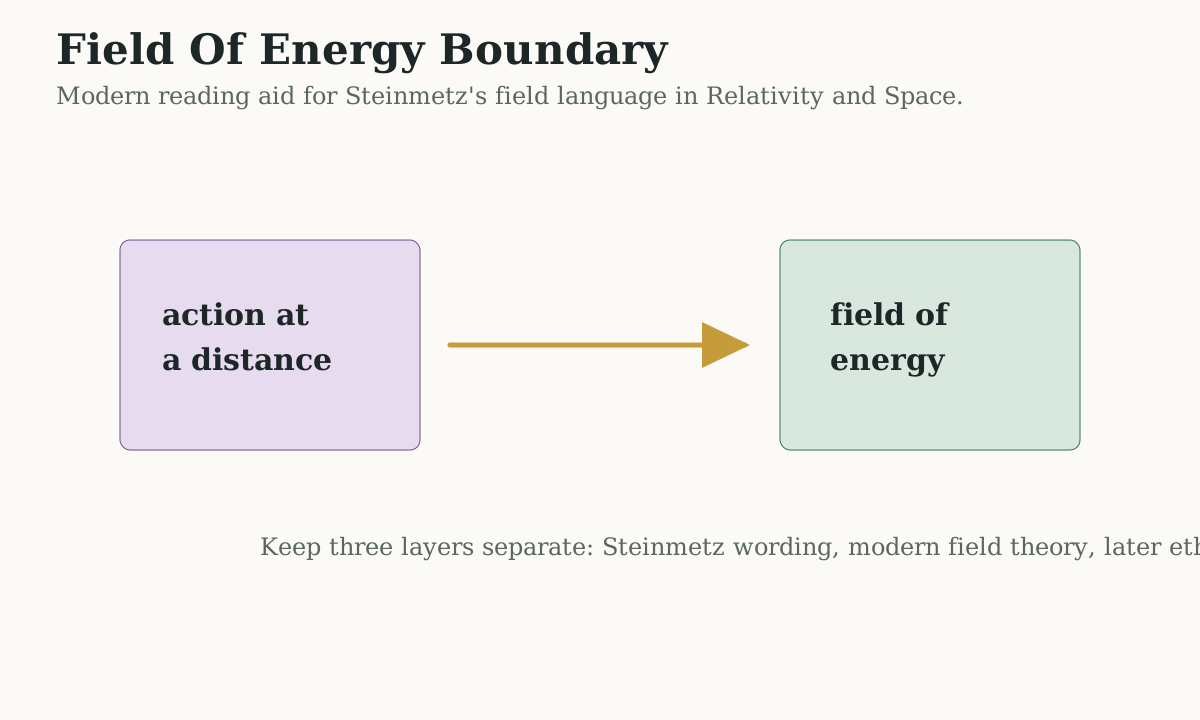
Field Of Energy Boundary
Modern reading aid for Steinmetz’s field language in Relativity and Space.
field-language, ether, relativity, energy-field
Candidate Figure References
Section titled “Candidate Figure References”| Candidate | Caption lead | Section | Routes |
|---|---|---|---|
four-lectures-relativity-space-fig-002Fig. 2 | M Fig. 2. 18 RELATIVITY AND SPACE | Lecture 2: Conclusions From The Relativity Theory | source workbench |
four-lectures-relativity-space-fig-004Fig. 4 | M Fig. 4. 22 RELATIVITY AND SPACE | Lecture 2: Conclusions From The Relativity Theory | source workbench |
four-lectures-relativity-space-fig-005Fig. 5 | none returned to the radiator. Fig. 5. CONCLUSIONS FROM RELATIVITY THEORY 23 | Lecture 2: Conclusions From The Relativity Theory | source workbench |
four-lectures-relativity-space-fig-006Fig. 6 | •^W///y/y/y/////////////‘//vy/////////’//^/^^////^>>^ Fig. 6. hour, relative to the track B. Let us denote the distance relative to the train — that is, measured in the train^ — ^by | Lecture 2: Conclusions From The Relativity Theory | source workbench |
four-lectures-relativity-space-fig-008Fig. 8 | and (2), are very similar to those representing a rotation of Fig. 8. the coordinate axes by an angle tan co = v/c. If it were such | Lecture 2: Conclusions From The Relativity Theory | source workbench |
four-lectures-relativity-space-fig-009Fig. 9 | r 7’ Fig. 9. P1P3’ is not the time but a combination of time and length. Inversely, to the second observer P1P3’ is the time and | Lecture 2: Conclusions From The Relativity Theory | source workbench |
four-lectures-relativity-space-fig-010Fig. 10 | R = M. Fig. 10. Let (in Fig. 10) 5 be a body revolving around a point 0. The fundamental law of physics is the law of inertia. | Lecture 3: Gravitation And The Gravitational Fleld | source workbench |
four-lectures-relativity-space-fig-014Fig. 14 | <^-<-r) B Fig. 14. constant speed in a straight line, but curves backward, just as it did in Fig. 13 on a 10 per cent up grade at constant | Lecture 3: Gravitation And The Gravitational Fleld | source workbench |
four-lectures-relativity-space-fig-015Fig. 15 | 7 ’ Fig. 15. standing near the track, shoot a rifle bullet through the car, | Lecture 3: Gravitation And The Gravitational Fleld | source workbench |
four-lectures-relativity-space-fig-016Fig. 16 | >Vf Fig. 16. leaves the car, at the point B of the track, it is greater and is v^. Then the angle which the bullet makes relative | Lecture 3: Gravitation And The Gravitational Fleld | source workbench |
four-lectures-relativity-space-fig-017Fig. 17 | until finally, at the extremely high velocity of light, c = Fig. 17. 186,000 miles per second, the hyperbola (6) becomes almost a straight line. Even if the beam of light comes very close | Lecture 3: Gravitation And The Gravitational Fleld | source workbench |
four-lectures-relativity-space-fig-020Fig. 20 | R = j/VK. (15) Fig. 20. E. THE STRAIGHT LINE AND THE ELLIPTIC 2-SPACE | Lecture 4: The Characteristics Of Space A. The Geometry Of The Gravitational Field | source workbench |
four-lectures-relativity-space-fig-021Fig. 21 | line between them, as Li or L2 — shown dotted in Fig. 21 — Fig. 21. is longer. Suppose we have a straight line L in the plane Fig. 21 and a point P outside of L. Any line drawn in the | Lecture 4: The Characteristics Of Space A. The Geometry Of The Gravitational Field | source workbench |
four-lectures-relativity-space-fig-025Fig. 25 | The mathematical n-space merely is the continuous mani- FiG. 25. fold of oo« elements which are given by the n ratios: x : y : | Lecture 4: The Characteristics Of Space A. The Geometry Of The Gravitational Field | source workbench |
four-lectures-relativity-space-fig-029Fig. 29 | however, are no part of projective geometry, as they are Fig. 29. made by its relation to infinity and therefore are metric in character : The hyperbola has two infinitely distant points, | Lecture 4: The Characteristics Of Space A. The Geometry Of The Gravitational Field | source workbench |
four-lectures-relativity-space-fig-030Fig. 30 | with regard to a conic, then the line connecting the points Fig. 30. pi and P2 is the polar of the point of intersection of Pi and | Lecture 4: The Characteristics Of Space A. The Geometry Of The Gravitational Field | source workbench |
four-lectures-relativity-space-fig-031Fig. 31 | of these six lines by e = ah, cd;f = ac, hd; g = ad, he, and Fig. 31. draw the three additional lines ef, eg and fg, we get a total of nine lines and four points on each of these nine lines. | Lecture 4: The Characteristics Of Space A. The Geometry Of The Gravitational Field | source workbench |
four-lectures-relativity-space-fig-032Fig. 32 | tant (that is, very far distant) we thus recognize by the Fig. 32. two lines of sight from our eyes to the object having the same direction. | Lecture 4: The Characteristics Of Space A. The Geometry Of The Gravitational Field | source workbench |
four-lectures-relativity-space-fig-033Fig. 33 | parallels Li and Lo through a point P — that is, two lines Fig. 33. which intersect L at infinity — and these tvv^o parallels Li and L2 make an angle L1PL2 with each other. Thus L] | Lecture 4: The Characteristics Of Space A. The Geometry Of The Gravitational Field | source workbench |